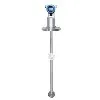
Hey there! As a supplier of High Accuracy Flowmeters, I'm super excited to dive into the different types of high - accuracy flowmeters available out there. These nifty devices are crucial in various industries, from manufacturing to food and beverage, and even in scientific research. So, let's get right into it!
Coriolis Mass Flowmeters
Coriolis mass flowmeters are like the rockstars of the high - accuracy flowmeter world. They're based on the Coriolis effect, which is a pretty cool physical phenomenon. When a fluid flows through a vibrating tube in the flowmeter, the Coriolis force causes the tube to twist. By measuring this twist, the flowmeter can accurately determine the mass flow rate of the fluid.
One of the biggest advantages of Coriolis mass flowmeters is their high accuracy. They can measure mass flow with an accuracy of up to 0.1% or even better in some cases. This makes them ideal for applications where precise measurements are a must, such as in the pharmaceutical industry for dosing drugs or in the chemical industry for mixing ingredients.
Another great thing about Coriolis mass flowmeters is that they can measure a wide range of fluids, including liquids, gases, and even slurries. They're also not affected by changes in fluid properties like density, viscosity, or temperature, which means you can get consistent and accurate measurements no matter what the conditions are.
If you're interested in learning more about mass flowmeters, you can check out this link: Mass Flowmeter. And if you're specifically looking for high - accuracy options, head over to High Accuracy Flowmeter.
Ultrasonic Flowmeters
Ultrasonic flowmeters are another popular type of high - accuracy flowmeter. They work by using ultrasonic waves to measure the flow of a fluid. There are two main types of ultrasonic flowmeters: transit - time and Doppler.
Transit - time ultrasonic flowmeters measure the difference in the time it takes for an ultrasonic wave to travel upstream and downstream in a fluid. By comparing these two times, the flowmeter can calculate the flow velocity of the fluid. This type of flowmeter is very accurate and can be used for clean liquids and gases.
Doppler ultrasonic flowmeters, on the other hand, work by measuring the frequency shift of an ultrasonic wave that is reflected off particles or bubbles in a fluid. This frequency shift is proportional to the flow velocity of the fluid. Doppler flowmeters are typically used for dirty or aerated fluids, where there are enough particles or bubbles to reflect the ultrasonic waves.
Ultrasonic flowmeters have several advantages. They're non - intrusive, which means they don't need to be inserted into the fluid stream. This makes them easy to install and maintain, and it also reduces the risk of contamination. They're also energy - efficient and can operate over a wide range of flow rates.
Magnetic Flowmeters
Magnetic flowmeters, also known as magmeters, are based on Faraday's law of electromagnetic induction. When a conductive fluid flows through a magnetic field generated by the flowmeter, a voltage is induced in the fluid. By measuring this voltage, the flowmeter can determine the flow rate of the fluid.
Magnetic flowmeters are highly accurate and can measure the flow of conductive liquids, such as water, wastewater, and many chemicals. They have no moving parts, which means there's less wear and tear, and they're also very reliable.
One of the key benefits of magnetic flowmeters is that they can measure bidirectional flow, which is useful in applications where the fluid can flow in both directions. They're also relatively unaffected by changes in fluid density, viscosity, and temperature, as long as the fluid remains conductive.
Positive Displacement Flowmeters
Positive displacement flowmeters are a bit different from the other types we've discussed. They work by trapping a fixed volume of fluid and then counting the number of times this volume is filled and emptied. This allows the flowmeter to measure the total volume of fluid that has passed through it.
These flowmeters are extremely accurate, especially for measuring low - flow rates. They're commonly used in applications where precise volume measurements are required, such as in fuel dispensing, metering of lubricants, and in the food and beverage industry for filling containers.
Positive displacement flowmeters can handle a wide range of viscosities, from thin liquids like gasoline to thick oils. However, they do have some limitations. They can be more expensive than other types of flowmeters, and they may require more maintenance due to the moving parts inside.
Turbine Flowmeters
Turbine flowmeters work by using a turbine or a rotor that is placed in the fluid stream. As the fluid flows through the flowmeter, it causes the turbine to rotate. The speed of the rotation is proportional to the flow velocity of the fluid, and by measuring this rotation speed, the flowmeter can determine the flow rate.
Turbine flowmeters are known for their high accuracy and fast response time. They're often used in applications where a quick and accurate measurement is needed, such as in the oil and gas industry for measuring the flow of hydrocarbons.
However, turbine flowmeters do have some drawbacks. They're sensitive to changes in fluid viscosity and density, and they may require a straight run of pipe upstream and downstream to ensure accurate measurements. They also have moving parts, which means they may need more maintenance over time.
Applications of High - Accuracy Flowmeters
High - accuracy flowmeters are used in a wide variety of industries. In the oil and gas industry, they're used to measure the flow of crude oil, natural gas, and refined products. Accurate flow measurements are crucial for custody transfer, where the amount of oil or gas being transferred between parties needs to be precisely determined.
In the pharmaceutical industry, high - accuracy flowmeters are used for dosing drugs and for monitoring the flow of fluids during the manufacturing process. This ensures that the drugs are produced with the right quality and dosage.
The food and beverage industry also relies heavily on high - accuracy flowmeters. They're used for measuring the flow of ingredients during the production process, as well as for filling containers with the correct amount of product. For example, in the production of beer, flowmeters are used to measure the flow of water, malt, and hops.
If you're in the market for a high - accuracy flowmeter for drinking water applications, you might want to check out Coriolis Mass Flowmeter for Drinking.
Why Choose Our High - Accuracy Flowmeters?
As a supplier of high - accuracy flowmeters, we offer a wide range of products to meet your specific needs. Our flowmeters are manufactured using the latest technology and high - quality materials, ensuring reliable and accurate performance.
We have a team of experts who can help you select the right flowmeter for your application. Whether you need a Coriolis mass flowmeter for precise mass measurements, an ultrasonic flowmeter for non - intrusive monitoring, or a magnetic flowmeter for conductive fluids, we've got you covered.
We also provide excellent after - sales service, including installation support, calibration, and maintenance. Our goal is to make sure that you're completely satisfied with your flowmeter and that it continues to perform at its best for years to come.
If you're interested in learning more about our high - accuracy flowmeters or if you have any questions, don't hesitate to get in touch. We're here to help you find the perfect solution for your flow measurement needs. Whether you're a small business or a large corporation, we can work with you to provide the right flowmeter at a competitive price.


So, if you're looking to upgrade your flow measurement system or if you're starting a new project that requires high - accuracy flowmeters, give us a shout. We're ready to assist you in making the right choice and getting your operations running smoothly.
References
- "Flow Measurement Handbook: Industrial Designs and Applications" by Richard W. Miller
- "Instrumentation, Measurement, and Analysis" by David A. Bell
- Manufacturer's literature and technical specifications for various flowmeters.