


Online Density Meter
HY Field Instrument Co., Ltd. has been focusing on field instruments for more than ten years. Our product lines include flowmeters, level meters, pressure transmitters, analytical instruments, etc. The main products include electromagnetic flowmeter, Coriolis mass flowmeter, vortex flowmeter, ultrasonic flowmeter; radar level meter, ultrasonic flowmeter, capacitive pressure transmitter, online density meter, etc.

Our Advantages
Advanced Production Equipment
Automatic welding machines, laser welding machines, argon arc welding machines, electric heating constant temperature ovens, spot welding machines, high and low temperature test chambers, calibration systems, etc. from well-known suppliers can ensure high-precision production of instruments.
Reliable Product Quality
Our company has passed ISO9001 certification, and our products have obtained CE, Exploreproof, Atex, and other certifications, with very high reliability.
Extensive Sales Market
Our products are exported to more than 80 countries and regions including the United States, Germany, France, Italy, Brazil, Chile, Vietnam, Saudi Arabia, and the United Arab Emirates, and have reached annual sales of more than 5 million US dollars.
Comprehensive Service
We provide professional product introduction, technical exchange, product design, troubleshooting, and other services. At the same time, technical and inspection personnel will conduct return visits to customers to continuously improve product experience.
-
![Top Mounted Online Density Meter]() Top Mounted Online Density MeterRead More
Top Mounted Online Density MeterRead MoreHYDP301 series online density (concentration) sensor is a continuous online measuring instrument of liquid density, mainly used for industrial process automation control. The corresponding 4-20mA
-
![Online Density Transmitter]() Online Density TransmitterRead More
Online Density TransmitterRead MoreHYDP301 series online density (concentration) sensor is a continuous online measuring instrument of liquid density, mainly used for industrial process automation control. The corresponding 4-20mA
-
![Online Liquid Density Meter]() Online Liquid Density MeterRead More
Online Liquid Density MeterRead MoreHYDP301online density (concentration) meter is a continuous online measuring instrument of liquid density, mainly used for industrial process automation control. The corresponding 4-20mA analog
-
![Fork Type Density Meter]() Fork Type Density MeterRead More
Fork Type Density MeterRead MoreThe HYFDM886 Series Fork Density (Concentration) meter is a continuous online measurement of liquid density and is used primarily for industrial process automation control. Density can be expressed
-
![DP Type Liquid Density Transmitter]() DP Type Liquid Density TransmitterRead More
DP Type Liquid Density TransmitterRead MoreIn many industries, the measurement of liquid density is a critical parameter for process control, quality assurance and production efficiency. One common method for measuring density is the use of
-
![Side Mounted Liquid Density Meter]() Side Mounted Liquid Density MeterRead More
Side Mounted Liquid Density MeterRead MoreHYDP301 series online density (concentration) sensor is a continuous online measuring instrument of liquid density, mainly used for industrial process automation control. The corresponding 4-20mA
-
![Liquid Density Meter]() Liquid Density MeterRead More
Liquid Density MeterRead MoreOn line differential density meter, also known as on-line density meter, is a device that measures the density of fluids or gases in real time during the industrial production process. It's used in
-
![Slurry Density Meter]() Slurry Density MeterRead More
Slurry Density MeterRead MoreHYDP301 series online density (concentration) sensor is a continuous online measuring instrument of liquid density, mainly used for industrial process automation control. The corresponding 4-20mA
-
![Online Concentration Transmitter]() Online Concentration TransmitterRead More
Online Concentration TransmitterRead MoreThe HYFDM886 Series Fork Density (Concentration) meter is a continuous online measurement of liquid density and is used primarily for industrial process automation control. Density can be expressed
-
![Fork Type Concentration Meter]() Fork Type Concentration MeterRead More
Fork Type Concentration MeterRead MoreThe HYFDM886 Series Fork Density (Concentration) meter is a continuous online measurement of liquid density and is used primarily for industrial process automation control. Density can be expressed
-
![Fork Type Concentration Transmitter]() Fork Type Concentration TransmitterRead More
Fork Type Concentration TransmitterRead MoreThe HYFDM886 Series Fork Density (Concentration) meter is a continuous online measurement of liquid density and is used primarily for industrial process automation control. Density can be expressed
-
![Sanitary Type Concentration Transmitter]() Sanitary Type Concentration TransmitterRead More
Sanitary Type Concentration TransmitterRead MoreThe HYFDM886 Series Fork Density (Concentration) meter is a continuous online measurement of liquid density and is used primarily for industrial process automation control. Density can be expressed


An industrial online density meter is a liquid density measurement that continuously measures the concentration and density of liquids which can be directly used in industrial production processes. The liquid density meter is a “plug and play, maintenance-free” concentration measuring instrument.
Types of Online Density Meter


1. Float Density Meter
The buoyancy force that the object receives in the fluid is related to the fluid density, and the greater the fluid density, the greater the buoyancy force. If the temperature of the sample to be measured is specified (for example, 25°C), the instrument can also use the specific gravity value as the scale value. The simplest of these instruments is the visual float-type glass hydrometer, referred to as the glass hydrometer.
2. Static Density Meter
The static pressure of a liquid column at a certain height is proportional to the density of the liquid, so the density of the liquid can be measured according to the static pressure value measured by the pressure measuring instrument. The diaphragm (see Diaphragm and Diaphragm) is a commonly used pressure measuring element, and a density meter that directly measures the static pressure of the sample liquid column with it is called a diaphragm static pressure density meter. Another commonly used one is the single tube blown density meter. It measures air pressure instead of the direct measurement of liquid column pressure. Insert the blowing tube to a certain depth below the liquid surface to be measured, and the compressed air will continuously escape from the bottom of the tube through the blowing tube. At this time, the pressure of the air in the tube is equal to the pressure of the sample liquid column at that height, and the pressure value can be converted into density.
3. Vibrating Density Meter
When an object is excited to vibrate, its vibration frequency or amplitude is related to the mass of the object itself. If a certain volume of the liquid sample is filled in the object, the change of its vibration frequency or amplitude will reflect the mass or density of the certain volume of sample liquid.
4. Radioisotope Density Meter
The instrument is equipped with a radioactive isotope radiation source. Its radioactive radiation (such as v-ray) is received by the radiation detector after passing through a certain thickness of the tested sample. The amount of radiation absorbed by a sample of a certain thickness is related to the density of the sample, and the signal of the radiation detector is related to the amount of absorption, thus reflecting the density of the sample.
Benefits of Online Density Meter
Real-Time Monitoring
Online density meters provide continuous and real-time density measurements, allowing for immediate feedback and proactive control of processes. This enables operators to make timely adjustments and optimize efficiency.
Accurate and Precise Measurements
Online density meters offer high accuracy and precision, ensuring reliable and consistent density readings. This helps maintain product quality, improve process control, and minimize errors and inconsistencies.
Quality Control
Online density meters contribute to effective quality control by monitoring and verifying product consistency. Deviations from desired density levels can be quickly detected, allowing for immediate corrective actions and ensuring adherence to desired specifications.
Automation and Integration
Online density meters can be integrated into process control systems, enabling automation and remote monitoring. This reduces manual intervention and enhances operational efficiency by providing seamless data integration with other process parameters.
Safety Enhancements
The real-time density measurements obtained from online density meters can contribute to improved safety in various industrial processes. It allows for better control and mitigation of potential safety risks associated with incorrect product formulations or process deviations.
Regulatory Compliance
With accurate density measurements, online density meters enable companies to meet regulatory requirements and industry standards. Compliance with specific density specifications ensures consistent product quality and facilitates audits and inspections.
Application of Online Density Meter
Concentration Determination
The determination of the concentration of binary solutions is one of the most important applications of density measurement. Binary solutions are mixtures of two components, such as alcohol-water solutions or sugar/water solutions. The density of a solution depends on the concentration of the dissolved substance (“solute”). If the interrelationship is known, the density of the solution can be measured and then be converted into the respective concentration. One example of a typical application is the determination of sugar content in the soft drink industry. A soft drink is considered a sugar-water solution and by density measurement the sugar content can be determined. Concentration determination is also possible if a mixture contains several components and only one of them varies while all other ingredients are constant.

Material Characterization
In industries like the petrochemical industry the density of a product is a very important characterization number or quality parameter. Norms including the ASTM norm define a certain density for every product, e.g. fuels, lubricating oils, or crude oils. Using density measurement these materials can be characterized and the quality of each product can be defined.
Academic Research
Density is also used in general as a standard parameter in professional academic research to get to know the special physical behavior of a product. In petrochemistry, scientists are used to measuring the density of gasoline at different pressures and temperatures in the laboratory to find out how it will react once injected into an engine.


Quality Control
Another important application of density measurement is quality control, not only in the soft drink or petrochemical industry, but also in the production of alcoholic beverages (beer, spirits, wine), fuels (including biodiesel and bioethanol), cosmetics, personal care products, pharmaceuticals, and many more.
Filling Volume Control
Whereas some products are quantified by their weight, others are filled, paid, or even taxed by their volume. A well-proven procedure is to measure the weight of a fluid product with a balance, followed by calculating the filling volume by using the density of the sample. This procedure is applied wherever the measurement of volumes is not possible, e.g. in the beverage industry, petroleum industry, or chemical industry.


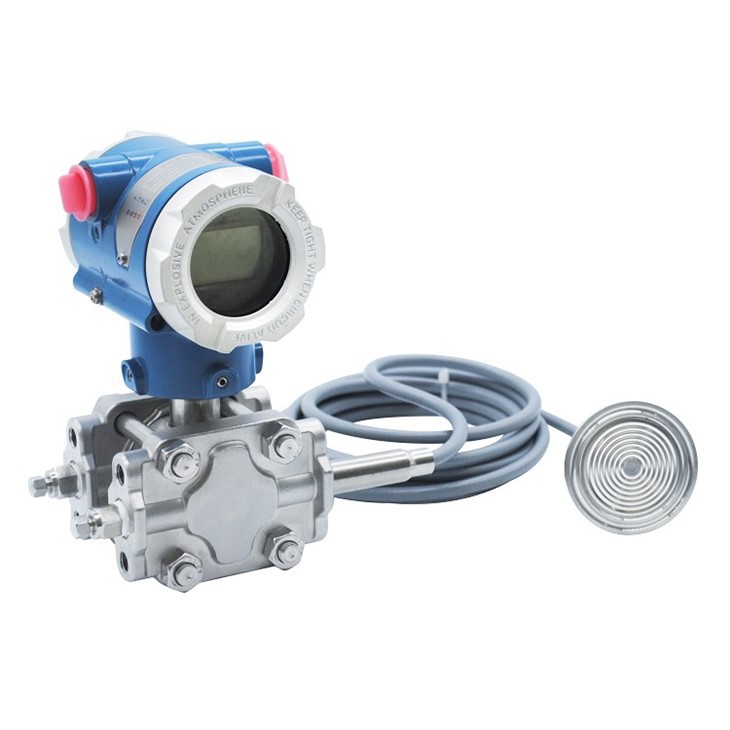
The density transmitter typically consists of a measuring cell, which is a hollow tube or cylinder immersed in the fluid whose density is to be measured. The measuring cell contains a vibrating element, such as a tuning fork or a quartz crystal, which vibrates at a frequency that is proportional to the density of the fluid.
As the fluid flows through the measuring cell, it causes the vibrating element to vibrate at a different frequency, which is detected by a sensor. The sensor then converts the frequency signal into an electrical signal, which is processed and displayed as a density reading.
The density transmitter may also include temperature and pressure sensors, which allow for compensation of changes in these variables that can affect the density measurement accuracy. Overall, the density transmitter provides a reliable and accurate measurement of the density of fluids in a variety of industrial applications, such as chemical processing, petroleum refining, and food production.
Factors That Affect the Measurement of Density
Meters for Liquids
When using a density meter for liquids, several factors can affect the accuracy and reliability of density measurements. It is important to consider and account for these factors to ensure precise results. Here are some key factors that can influence density measurement when using a density meter for liquids:
Temperature
Temperature variations can significantly impact the density of liquids. Most density meters have temperature compensation features or require temperature inputs to adjust the density readings accordingly. It is crucial to measure and control the temperature of the liquid being tested to obtain accurate density measurements.
Viscosity
The viscosity of a liquid can affect the flow and movement of the liquid within the density meter, potentially impacting the measurement. High-viscosity liquids may require special handling or specific density meter designs capable of accommodating their properties.
Air Bubbles
Air bubbles trapped within the liquid sample can affect the density measurement. These bubbles can alter the effective volume and density of the liquid, leading to erroneous readings. It is essential to degas or remove air bubbles from the liquid before measurement, if possible.
Sample Homogeneity
The uniformity or homogeneity of the liquid sample can impact density measurements. If the liquid contains suspended particles, emulsions, or other inhomogeneous components, it may lead to inconsistent density readings. Proper sample preparation, including thorough mixing and removal of any settled particles, is necessary for accurate measurements.
Contamination
Contaminants or impurities in the liquid can introduce errors in density measurements. Foreign substances that have different densities or chemical compositions from the liquid being tested can affect the density readings. It is important to ensure that the liquid sample is clean and free from any contamination.
Calibration
Regular calibration of the density meter is crucial for accuracy. Calibration involves comparing the density meter readings against known standards or reference liquids with known densities. Proper calibration ensures that the density meter is providing reliable and accurate measurements.
Instrument Limitations
Each density meter has its own limitations and specifications. It is essential to understand the capabilities, operating range, and limitations of the density meter being used. Adhering to the manufacturer’s guidelines and instructions for proper usage is important to obtain accurate density measurements.
When it comes to choosing a density meter, there are a few things that you need to consider. First of all, you need to determine the specific requirements of your applications within your industry and within your budget. Identifying the following factors will help you choose a density meter:
Our Certificate
In order to ensure the quality of our products, our company has passed ISO9001 quality system certification, and our products have obtained CE, Exploreproof, Atex, and other certifications.


Our modern factory is equipped with multiple production lines. The flow meters, liquid level meters, pressure transmitters, temperature sensors, and transmitters we produce are widely used in the petrochemical industry, natural gas, environmental engineering, pharmaceutical engineering, food engineering, water treatment, Marine engineering, and other fields.
Ultimate FAQ Guide to Flowmeters
As one of the most professional online density meter manufacturers and suppliers in China, we're featured by quality products and low price. Please rest assured to buy customized online density meter from our factory. Contact us for pricelist and quotation.