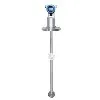
What is the response time of an Oval Gear Flowmeter?
Hey there! I'm a supplier of Oval Gear Flowmeters, and I often get asked about the response time of these nifty devices. So, let's dive right in and break it down.
First off, what's an Oval Gear Flowmeter anyway? Well, it's a type of positive displacement flowmeter that uses two oval gears that intermesh and rotate within a measuring chamber. As fluid flows through the chamber, it causes the gears to rotate, and by counting the rotations, we can measure the volume of fluid that has passed through.
Now, the response time of an Oval Gear Flowmeter is a crucial factor, especially in applications where quick and accurate measurements are needed. The response time refers to how quickly the flowmeter can detect a change in the flow rate and provide an updated measurement.
There are a few things that can affect the response time of an Oval Gear Flowmeter. One of the main factors is the viscosity of the fluid being measured. Fluids with higher viscosities tend to flow more slowly, which can increase the response time. For example, if you're measuring a thick oil, it might take a bit longer for the flowmeter to register a change in flow compared to a thinner liquid like water.
Another factor is the size of the flowmeter. Larger flowmeters generally have a slower response time because there's more fluid to move through the measuring chamber. So, if you need a fast response, you might want to consider a smaller-sized flowmeter.
The design of the flowmeter also plays a role. Some Oval Gear Flowmeters are designed with features that can improve the response time, such as optimized gear profiles and low-friction bearings. These design elements can help the gears rotate more smoothly and quickly, reducing the time it takes to detect a flow change.
In general, the response time of an Oval Gear Flowmeter can range from a few milliseconds to several seconds. For applications where rapid changes in flow need to be monitored, like in some industrial processes or fuel injection systems, a flowmeter with a shorter response time is essential.
Let's take a look at some real-world applications. In the oil and gas industry, Oval Gear Flowmeters are often used to measure the flow of diesel oil. For these applications, a fast response time is crucial to ensure accurate fuel consumption measurements and to detect any sudden changes in flow that could indicate a problem. If you're interested in an Oval Gear Flowmeter for diesel oil, you can check out this link: Oval Gear Flowmeter for Diesel Oil.
Similarly, in automotive applications, Oval Gear Flowmeters can be used to measure the flow of diesel fuel to the engine. A quick response time helps in maintaining optimal engine performance and can also assist in diagnosing fuel system issues. You can find more information about an Oval Gear Flow Meter For Diesel here: Oval Gear Flow Meter For Diesel.
Now, how can you ensure that you're getting the best response time from your Oval Gear Flowmeter? Well, proper installation is key. Make sure the flowmeter is installed in a location where the fluid flow is smooth and free from turbulence. Turbulent flow can disrupt the rotation of the gears and increase the response time.
Regular maintenance is also important. Over time, debris and contaminants can build up in the measuring chamber, which can slow down the gears and affect the response time. By keeping the flowmeter clean and well-maintained, you can ensure that it continues to provide accurate and timely measurements.


If you're in the market for an Oval Gear Flowmeter and you need a specific response time for your application, don't hesitate to reach out to us. We have a wide range of flowmeters with different specifications, and our team of experts can help you choose the right one for your needs. Whether you're looking for a flowmeter for a small-scale project or a large industrial application, we've got you covered.
In conclusion, the response time of an Oval Gear Flowmeter is an important consideration when choosing a flow measurement device. It's influenced by factors like fluid viscosity, flowmeter size, and design. By understanding these factors and taking steps to optimize the installation and maintenance of the flowmeter, you can ensure that you get the best performance and accurate measurements. So, if you have any questions or are ready to start the procurement process, just give us a shout, and we'll be happy to assist you.
References
- Flow Measurement Handbook: Principles and Practice, by Richard W. Miller
- Positive Displacement Flowmeters: Theory and Application, by various authors in the field of flow measurement