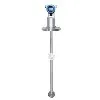
As a supplier of Roots Flowmeters for Gas, I often encounter inquiries from customers about the maximum flow rate that these flowmeters can measure. This is a crucial aspect, as the accurate measurement of gas flow is essential in various industries, from oil and gas to chemical processing. In this blog, I will delve into the factors that determine the maximum flow rate of a Roots flowmeter for gas, its significance, and how our products stand out in the market.
Understanding Roots Flowmeters for Gas
Before we discuss the maximum flow rate, let's briefly understand what a Roots flowmeter for gas is. A Roots Flowmeter for Gas is a positive displacement flowmeter that operates on the principle of measuring the volume of gas passing through it. It consists of two rotors with lobes that intermesh and rotate in opposite directions. As the gas enters the flowmeter, it fills the spaces between the lobes and the housing. The rotation of the rotors causes the gas to be trapped and then discharged in discrete volumes. By counting the number of rotations, the flowmeter can accurately measure the volume of gas that has passed through it.
One of the key advantages of Roots flowmeters for gas is their high accuracy and repeatability, even at low flow rates. They are also suitable for a wide range of gases, including natural gas, propane, and air. These flowmeters are commonly used in applications where precise measurement of gas consumption or transfer is required, such as in custody transfer, industrial process control, and energy management.


Factors Affecting the Maximum Flow Rate
The maximum flow rate that a Roots flowmeter for gas can measure is determined by several factors, including the design of the flowmeter, the size of the rotors, and the operating conditions.
Design of the Flowmeter
The design of the flowmeter plays a crucial role in determining its maximum flow rate. A well-designed flowmeter will have a smooth internal flow path that minimizes pressure drop and turbulence. This allows the gas to flow through the flowmeter more easily, enabling it to handle higher flow rates. Additionally, the materials used in the construction of the flowmeter can also affect its performance. For example, flowmeters made from high-quality materials are more resistant to wear and corrosion, which can help maintain their accuracy and reliability over time.
Size of the Rotors
The size of the rotors is another important factor that affects the maximum flow rate. Larger rotors can handle larger volumes of gas, allowing the flowmeter to measure higher flow rates. However, larger rotors also require more space and may be more expensive to manufacture. Therefore, the size of the rotors needs to be carefully selected based on the specific application requirements.
Operating Conditions
The operating conditions, such as the pressure and temperature of the gas, can also have a significant impact on the maximum flow rate. Higher pressure and temperature can increase the density of the gas, which can reduce the volume of gas that the flowmeter can handle. Therefore, it is important to select a flowmeter that is designed to operate within the specific pressure and temperature range of the application.
Significance of the Maximum Flow Rate
The maximum flow rate is an important parameter to consider when selecting a Roots flowmeter for gas. It determines the range of flow rates that the flowmeter can measure accurately. If the flow rate exceeds the maximum flow rate of the flowmeter, it can lead to inaccurate measurements and reduced performance. On the other hand, if the flow rate is much lower than the maximum flow rate, the flowmeter may not be able to provide accurate measurements due to its limited sensitivity.
In applications where the flow rate varies widely, it is important to select a flowmeter with a wide turndown ratio. The turndown ratio is the ratio of the maximum flow rate to the minimum flow rate that the flowmeter can measure accurately. A higher turndown ratio allows the flowmeter to measure a wider range of flow rates, making it more versatile and suitable for a variety of applications.
Our Roots Flowmeters for Gas
As a leading supplier of Gas Roots Flowmeter, we offer a wide range of products that are designed to meet the diverse needs of our customers. Our flowmeters are available in various sizes and configurations, with maximum flow rates ranging from a few cubic meters per hour to several thousand cubic meters per hour.
One of the key features of our Roots flowmeters for gas is their high accuracy and reliability. We use advanced manufacturing techniques and high-quality materials to ensure that our flowmeters provide accurate and consistent measurements over a long period of time. Our flowmeters are also designed to be easy to install and maintain, reducing the overall cost of ownership.
In addition to our standard products, we also offer customized solutions to meet the specific requirements of our customers. Our team of experienced engineers can work with you to design and develop a flowmeter that is tailored to your application. Whether you need a flowmeter for a high-pressure application or a low-flow application, we can provide you with a solution that meets your needs.
Contact Us for Purchase and Negotiation
If you are looking for a reliable and accurate Gas Flowmeter for your application, look no further. Our Roots flowmeters for gas are designed to provide the highest level of performance and reliability. We offer competitive pricing, excellent customer service, and fast delivery times.
To learn more about our products and services, or to discuss your specific requirements, please contact us. Our sales team will be happy to assist you and provide you with a detailed quotation. We look forward to working with you and helping you find the perfect flowmeter for your application.
References
- ISO 9951:2019, Gas meters - Roots type.
- OIML R 137-1:2012, Measuring systems for the metering of natural gas and related fluids - Part 1: Metering systems.
- AGA Report No. 7:2018, Measurement of Gas by Rotary Displacement Meters.