Linearity is a crucial concept when it comes to the performance of an Ultrasonic Level Meter. As a supplier of Ultrasonic Level Meters, understanding and explaining the linearity of these devices is essential for our customers to make informed decisions about their applications.
What is Linearity in an Ultrasonic Level Meter?
Linearity in an Ultrasonic Level Meter refers to the relationship between the actual level of a substance in a tank or container and the output signal provided by the meter. In an ideal scenario, this relationship is a straight - line function. That is, for every unit change in the actual level of the substance, there is a corresponding proportional change in the output signal of the meter.
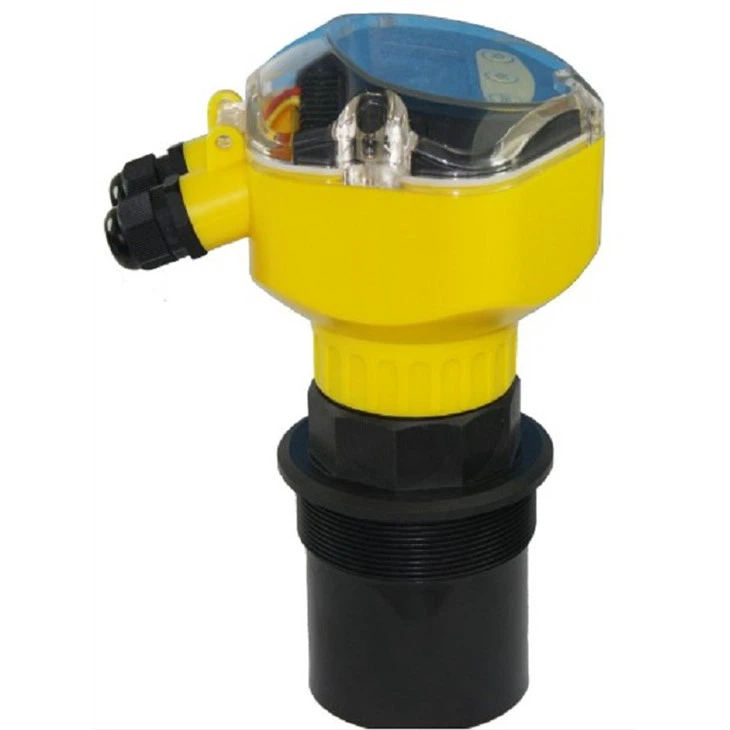

Let's break this down further. An Ultrasonic Level Meter Ultrasonic Level Meter works by emitting ultrasonic waves towards the surface of the substance whose level is to be measured. These waves travel through the air or other medium above the substance, bounce off the surface, and then return to the meter. The meter measures the time it takes for the waves to travel to the surface and back, and based on the known speed of sound in the medium, it calculates the distance to the surface. From this distance, the level of the substance in the container can be determined.
The output of the Ultrasonic Level Meter is typically in the form of an electrical signal, such as a 4 - 20 mA current loop or a digital signal. A perfectly linear Ultrasonic Level Meter would have an output signal that changes in a completely proportional manner with the change in the actual level of the substance. For example, if the meter is calibrated to measure a level range from 0 to 10 meters, and the output signal is a 4 - 20 mA current loop, at 0 meters, the output would be 4 mA, and at 10 meters, the output would be 20 mA. For every 1 - meter increase in the level, the output current would increase by 1.6 mA (since (20 - 4)/10 = 1.6).
Importance of Linearity
The linearity of an Ultrasonic Level Meter is of utmost importance for several reasons. Firstly, it ensures accurate and reliable level measurements. In industrial processes, precise level measurement is often critical for maintaining process efficiency, product quality, and safety. For example, in a chemical processing plant, over - filling or under - filling of a tank can lead to chemical reactions going out of control, resulting in product waste, equipment damage, or even safety hazards. A linear Ultrasonic Level Meter provides consistent and accurate readings, allowing operators to make informed decisions about the amount of substance in the tank and take appropriate actions.
Secondly, linearity simplifies the integration of the Ultrasonic Level Meter into control systems. Most industrial control systems are designed to work with linear input signals. When an Ultrasonic Level Meter has good linearity, it can be easily interfaced with these control systems, and the control algorithms can be accurately calibrated based on the linear relationship between the level and the output signal. This makes it easier to automate processes, such as filling and emptying of tanks, and to maintain a stable and efficient operation.
Factors Affecting Linearity
Several factors can affect the linearity of an Ultrasonic Level Meter. One of the main factors is the presence of obstacles or disturbances in the path of the ultrasonic waves. For example, if there are pipes, agitators, or other objects in the tank, they can cause the ultrasonic waves to scatter or reflect in unexpected ways. This can lead to inaccurate distance measurements and a deviation from the linear relationship between the actual level and the output signal.
The properties of the medium through which the ultrasonic waves travel can also impact linearity. The speed of sound in a medium depends on factors such as temperature, pressure, and humidity. If these conditions change during the operation of the Ultrasonic Level Meter, the speed of sound will also change, which can affect the calculated distance to the surface of the substance and thus the linearity of the measurement. For instance, an increase in temperature generally causes an increase in the speed of sound, which can lead to an over - estimation of the level if the meter is not compensated for the temperature change.
The surface characteristics of the substance being measured can also play a role. If the surface is rough, foamy, or has a sloping shape, the ultrasonic waves may not reflect back to the meter in a consistent manner. This can result in fluctuations in the measured distance and a non - linear output signal.
Measuring and Improving Linearity
To ensure the linearity of an Ultrasonic Level Meter, it is important to measure and calibrate it regularly. Calibration involves comparing the output signal of the meter with known reference levels. This can be done using a calibration tank with precisely measured levels. By measuring the output signal at different known levels, a calibration curve can be plotted. In an ideal linear meter, this curve would be a straight line. Any deviation from the straight line indicates a non - linearity in the meter's performance.
There are several ways to improve the linearity of an Ultrasonic Level Meter. One approach is to use advanced signal processing techniques. Modern Ultrasonic Level Meters are equipped with sophisticated algorithms that can filter out noise and interference, and correct for the effects of obstacles and surface irregularities. These algorithms can analyze the received ultrasonic signals and extract the most accurate information about the distance to the surface, thereby improving the linearity of the measurement.
Another way is to compensate for changes in the medium properties. For example, many Ultrasonic Level Meters are equipped with temperature sensors that can measure the temperature of the medium. Based on the measured temperature, the meter can adjust the speed of sound used in the distance calculation, ensuring that the linear relationship between the level and the output signal is maintained even when the temperature changes.
Our Ultrasonic Level Meters and Linearity
As a supplier of Ultrasonic Level Meters, we take great pride in the linearity performance of our products. Our Ultrasonic Level Meters are designed with state - of - the - art technology to minimize the effects of factors that can affect linearity. We use high - quality ultrasonic transducers that emit and receive waves with high precision, reducing the impact of signal scattering and interference.
Our meters are also equipped with advanced signal processing algorithms that can accurately analyze the received signals and provide linear output signals even in challenging environments. Additionally, we offer temperature compensation features as standard in most of our models, ensuring that the linearity of the measurement is maintained regardless of temperature variations.
We understand that different applications have different requirements for linearity. That's why we offer a range of Ultrasonic Level Meters with varying levels of accuracy and linearity performance. Whether you need a meter for a simple level monitoring application or a highly precise measurement in a critical industrial process, we have a solution that can meet your needs.
Conclusion
In conclusion, the linearity of an Ultrasonic Level Meter is a fundamental characteristic that determines its accuracy, reliability, and usability in industrial applications. Understanding the concept of linearity, the factors that affect it, and how to measure and improve it is essential for both suppliers and users of these devices.
As a leading supplier of Ultrasonic Level Meters, we are committed to providing our customers with high - quality products that offer excellent linearity performance. If you are in the market for an Ultrasonic Level Meter and have specific requirements regarding linearity or other performance parameters, we encourage you to contact us for a detailed discussion. Our team of experts is ready to assist you in selecting the right meter for your application and to provide you with the best possible support throughout the procurement and installation process.
References
- Beckwith, T. G., Buck, N. L., & Marangoni, R. D. (2007). Mechanical Measurements. Addison - Wesley.
- Doebelin, E. O. (2003). Measurement Systems: Application and Design. McGraw - Hill.
- Kutz, M. (2006). Instrumentation and Controls Sourcebook. McGraw - Hill.