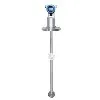
Hey there! As a supplier of High Accuracy Flowmeters, I often get asked about the differences between in - line and insertion high accuracy flowmeters. So, I thought I'd take the time to break it down for you all in this blog post.
Let's start with the basics. First off, what are flowmeters? Well, flowmeters are devices that measure the flow rate of a fluid (either liquid or gas) in a pipe or an open channel. High accuracy flowmeters, like the ones we offer at [we'll just assume we're a well - known supplier here], are designed to give really precise measurements. You can check out our High Accuracy Flowmeter on our website for more details.
In - line High Accuracy Flowmeters
In - line flowmeters are installed directly into the pipeline. They replace a section of the pipe, and the fluid flows through the flowmeter itself. One of the big advantages of in - line flowmeters is their high accuracy. Since the fluid passes directly through the measuring element, there are fewer factors that can affect the measurement.
For example, Coriolis Flowmeters are a type of in - line high accuracy flowmeter. These meters work based on the Coriolis effect. When a fluid flows through a vibrating tube in the flowmeter, the Coriolis force causes the tube to twist. By measuring this twist, the flowmeter can accurately determine the mass flow rate of the fluid.
In - line flowmeters are great for applications where you need extremely precise measurements. They're commonly used in industries like chemical processing, where even a small error in flow measurement can lead to big problems in the production process. They're also used in the food and beverage industry, especially for applications like measuring the flow of Coriolis Mass Flowmeter for Drinking water or other beverages.
However, in - line flowmeters also have some drawbacks. They can be more expensive to install compared to insertion flowmeters. You need to shut down the pipeline, cut out a section of the pipe, and then install the flowmeter. This can be time - consuming and costly, especially in large - scale industrial applications. Also, they require more maintenance since they're directly in the flow path of the fluid, and they can be more prone to wear and tear.
Insertion High Accuracy Flowmeters
Insertion flowmeters, on the other hand, are installed by inserting the measuring element into the pipeline through a small hole. They don't replace a section of the pipe. Instead, they sit inside the pipe and measure the flow rate of the fluid as it passes by.
One of the main advantages of insertion flowmeters is their ease of installation. You don't need to shut down the entire pipeline to install them. You can simply drill a hole in the pipe, insert the flowmeter, and then seal it up. This makes them a more cost - effective option for many applications, especially when you need to retrofit an existing pipeline.
Insertion flowmeters are also less intrusive. Since they don't replace a section of the pipe, they have less impact on the flow of the fluid. This can be important in applications where maintaining a smooth flow is crucial.
However, insertion flowmeters may not be as accurate as in - line flowmeters. The measuring element only samples a small portion of the fluid flow in the pipe. If the flow profile in the pipe is not uniform, this can lead to measurement errors. Also, the accuracy of insertion flowmeters can be affected by factors like the location of the insertion point and the orientation of the measuring element.
Comparing the Two
Let's take a more detailed look at how these two types of flowmeters compare in different aspects:
Accuracy
As mentioned earlier, in - line flowmeters generally offer higher accuracy. They measure the entire flow of the fluid passing through the pipe, so they can provide more precise readings. Insertion flowmeters, while still capable of high accuracy in some cases, may have some limitations due to the fact that they only sample a portion of the flow.
Installation
In - line flowmeters require a more complex installation process. You need to cut the pipe, which often means shutting down the system. Insertion flowmeters, on the other hand, can be installed much more quickly and easily, usually without shutting down the pipeline.
Cost
In - line flowmeters are usually more expensive. The cost of the flowmeter itself is often higher, and the installation costs can add up significantly. Insertion flowmeters are generally more budget - friendly, both in terms of the device cost and the installation cost.
Maintenance
In - line flowmeters need more maintenance. Since they're directly in the flow path, they're more likely to be affected by the fluid's properties, such as corrosion or abrasion. Insertion flowmeters are less exposed to the full force of the fluid flow, so they may require less maintenance.
Application
In - line flowmeters are ideal for applications where high precision is a must, such as in the pharmaceutical or high - end chemical industries. Insertion flowmeters are a good choice for applications where cost - effectiveness and ease of installation are important, like in some municipal water supply systems or smaller - scale industrial processes.
Which One Should You Choose?
The choice between in - line and insertion high accuracy flowmeters depends on your specific needs. If you need the highest possible accuracy and cost is not a major concern, then an in - line flowmeter is probably the way to go. But if you're looking for a more cost - effective and easier - to - install solution, and you can tolerate a slightly lower level of accuracy, then an insertion flowmeter might be a better fit.
We at [our assumed supplier] have a wide range of both in - line and insertion high accuracy flowmeters. Our team of experts can help you choose the right flowmeter for your application. Whether you're in the food and beverage industry, chemical processing, or any other field that requires accurate flow measurement, we've got you covered.
If you're interested in learning more about our products or have any questions about which flowmeter is right for you, don't hesitate to reach out. We're always happy to have a chat and help you make the best decision for your business. We can discuss your specific requirements, and even provide you with a quote. So, why not take the next step and start a conversation with us today? Let's work together to find the perfect high accuracy flowmeter solution for your needs.


References
- "Flow Measurement Handbook: Industrial Designs and Applications" by Richard W. Miller.
- "Principles of Flow Measurement" by R. W. Miller.