When it comes to measuring fluid flow in various industrial applications, two commonly used types of flowmeters are vortex flowmeters and electromagnetic flowmeters. As a supplier of vortex flowmeters, I am often asked about the differences between these two technologies. In this blog post, I will delve into the characteristics, working principles, advantages, and limitations of both vortex flowmeters and electromagnetic flowmeters to help you make an informed decision for your specific flow measurement needs.
Working Principles
Vortex Flowmeters
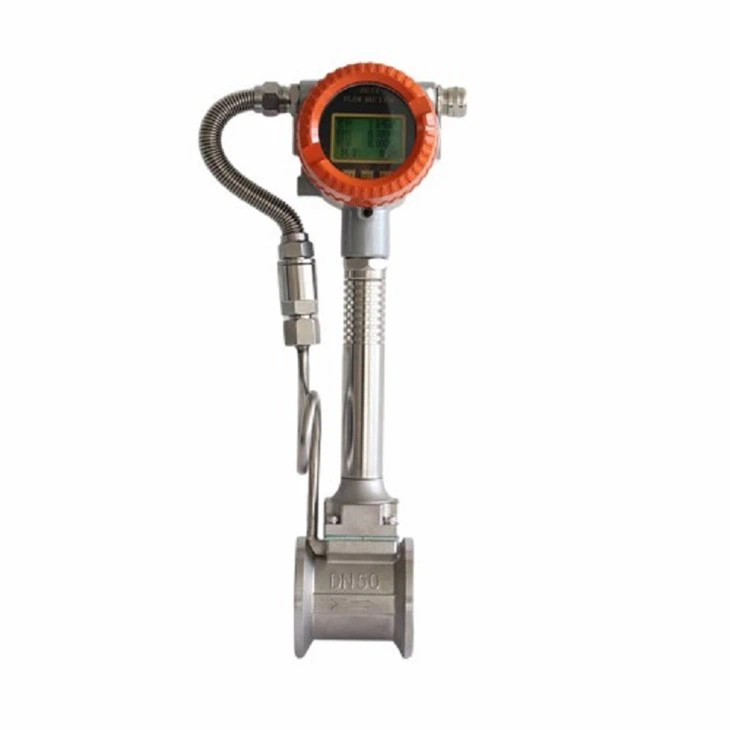
Vortex flowmeters operate based on the principle of the von Kármán vortex street. When a fluid flows past a bluff body (also known as a shedder bar) placed in the flow path, alternating vortices are shed on either side of the bluff body. The frequency of these vortices is directly proportional to the flow velocity of the fluid. By detecting the frequency of the vortices, the flow rate of the fluid can be determined.
The detection of the vortices is typically achieved using a sensor, such as a piezoelectric sensor or a capacitive sensor, which converts the mechanical vibrations caused by the vortices into electrical signals. These signals are then processed by the flowmeter's electronics to calculate the flow rate.
Vortex flowmeters are suitable for measuring the flow of both liquids and gases, including steam. They are commonly used in applications such as HVAC systems, chemical processing, and power generation. For more information on specific types of vortex flowmeters, you can visit our website to learn about Temperature And Pressure Compensate Vortex Flowmeter, Temperature And Pressure Compensate Flowmeter, and Steam Flowmeter.
Electromagnetic Flowmeters
Electromagnetic flowmeters, also known as magmeters, operate based on Faraday's law of electromagnetic induction. According to this law, when a conductive fluid flows through a magnetic field, an electromotive force (EMF) is induced perpendicular to both the direction of the fluid flow and the magnetic field. The magnitude of this EMF is proportional to the average velocity of the fluid and the strength of the magnetic field.
Electromagnetic flowmeters consist of a flow tube with electrodes installed on its inner walls and a magnetic coil that generates a magnetic field across the flow tube. As the conductive fluid flows through the magnetic field, the induced EMF is detected by the electrodes and measured by the flowmeter's electronics. The measured EMF is then used to calculate the flow rate of the fluid.
Electromagnetic flowmeters are primarily used for measuring the flow of conductive liquids, such as water, wastewater, and slurries. They are widely used in industries such as water treatment, food and beverage, and pharmaceuticals.

Advantages and Limitations
Vortex Flowmeters
Advantages
- Wide range of applications: Vortex flowmeters can measure the flow of both liquids and gases, including steam, making them suitable for a variety of industrial applications.
- High accuracy: Vortex flowmeters can provide accurate flow measurements over a wide range of flow rates, typically with an accuracy of ±1% to ±2% of the measured value.
- Low maintenance: Vortex flowmeters have no moving parts, which reduces the need for maintenance and minimizes the risk of mechanical failure.
- Cost-effective: Vortex flowmeters are generally more cost-effective than some other types of flowmeters, especially for applications requiring high accuracy and reliability.
Limitations
- Limited low-flow performance: Vortex flowmeters may have difficulty measuring very low flow rates due to the low frequency of the vortices at low velocities.
- Sensitivity to flow disturbances: Vortex flowmeters are sensitive to flow disturbances, such as swirl and turbulence, which can affect the accuracy of the measurements. Adequate straight pipe runs upstream and downstream of the flowmeter are required to ensure accurate measurements.
- Not suitable for non-Newtonian fluids: Vortex flowmeters are designed for use with Newtonian fluids, and their performance may be affected when measuring non-Newtonian fluids, such as slurries and viscous liquids.
Electromagnetic Flowmeters
Advantages
- High accuracy: Electromagnetic flowmeters can provide highly accurate flow measurements, typically with an accuracy of ±0.5% to ±1% of the measured value.
- No pressure drop: Electromagnetic flowmeters have no moving parts or obstructions in the flow path, which results in no pressure drop across the flowmeter. This can save energy and reduce operating costs in fluid systems.
- Suitable for conductive liquids: Electromagnetic flowmeters are specifically designed for measuring the flow of conductive liquids, and they can provide accurate measurements even for liquids with high solids content or viscosity.
- Easy installation and maintenance: Electromagnetic flowmeters are relatively easy to install and require minimal maintenance. They have no moving parts that can wear out or require replacement.
Limitations
- Limited to conductive fluids: Electromagnetic flowmeters can only be used to measure the flow of conductive liquids. They are not suitable for measuring the flow of non-conductive fluids, such as gases and oils.
- High initial cost: Electromagnetic flowmeters are generally more expensive than some other types of flowmeters, especially for larger pipe sizes.
- Sensitivity to magnetic interference: Electromagnetic flowmeters are sensitive to magnetic interference from external sources, such as motors and transformers. Proper shielding and installation practices are required to minimize the effects of magnetic interference.
Comparison of Key Features
| Feature | Vortex Flowmeter | Electromagnetic Flowmeter |
|---|---|---|
| Fluid type | Liquids, gases, steam | Conductive liquids |
| Accuracy | ±1% to ±2% | ±0.5% to ±1% |
| Pressure drop | Low | Negligible |
| Maintenance | Low | Low |
| Cost | Relatively low | Relatively high |
| Installation requirements | Adequate straight pipe runs | Minimal straight pipe runs |
| Sensitivity to flow disturbances | High | Low |
| Sensitivity to magnetic interference | Low | High |
Choosing the Right Flowmeter
When choosing between a vortex flowmeter and an electromagnetic flowmeter, several factors need to be considered, including the type of fluid to be measured, the required accuracy, the flow range, the installation environment, and the budget.
If you need to measure the flow of liquids, gases, or steam, and you require a cost-effective solution with a wide range of applications, a vortex flowmeter may be the right choice for you. On the other hand, if you need to measure the flow of conductive liquids and you require high accuracy and low pressure drop, an electromagnetic flowmeter may be more suitable.
As a supplier of vortex flowmeters, we can provide you with detailed information and technical support to help you choose the right flowmeter for your specific application. Our team of experts can also assist you with the installation, calibration, and maintenance of the flowmeter to ensure optimal performance.
Conclusion
In conclusion, both vortex flowmeters and electromagnetic flowmeters are valuable tools for measuring fluid flow in various industrial applications. Each type of flowmeter has its own unique advantages and limitations, and the choice between them depends on the specific requirements of the application.
If you have any questions or need further information about our vortex flowmeters or other flow measurement solutions, please do not hesitate to contact us. We are committed to providing you with high-quality products and excellent customer service to meet your flow measurement needs. Let's start a conversation to explore how our vortex flowmeters can benefit your operations and help you achieve accurate and reliable flow measurements.
References
- Spitzer, D. W. (2001). Flow Measurement: Practical Guides for Measurement and Control. ISA - The Instrumentation, Systems, and Automation Society.
- Miller, R. W. (1996). Flow Measurement Engineering Handbook. McGraw-Hill Professional.