

As a supplier of Oval Gear Flowmeters, I often get asked about how the energy consumption of our Oval Gear Flowmeters stacks up against other types of flowmeters. In this blog post, I'll delve into the details of energy consumption across different flowmeter technologies, highlighting the unique features of Oval Gear Flowmeters and how they compare in terms of energy efficiency.
Understanding Flowmeters and Their Energy Requirements
Flowmeters are essential devices in various industries, used to measure the flow rate of liquids and gases. Different types of flowmeters operate on distinct principles, and these principles significantly influence their energy consumption. Before we compare the energy consumption of Oval Gear Flowmeters, let's briefly look at some common types of flowmeters and how they work.
- Orifice Plate Flowmeters: These are one of the most traditional flow measurement devices. They work by creating a constriction in the flow path, causing a pressure drop. The pressure difference is then used to calculate the flow rate. Orifice plate flowmeters typically don't require external power to operate, but they do cause a permanent pressure loss in the system, which can increase the energy required to pump the fluid through the pipeline.
- Magnetic Flowmeters: Based on Faraday's law of electromagnetic induction, magnetic flowmeters measure the flow rate of conductive fluids. They require an external power source to generate a magnetic field. The energy consumption of magnetic flowmeters depends on the size of the meter and the strength of the magnetic field needed.
- Turbine Flowmeters: Turbine flowmeters use the kinetic energy of the flowing fluid to rotate a turbine. The rotation speed is proportional to the flow rate. These flowmeters usually need power for signal processing and transmission, and the energy consumption can vary depending on the electronics and the operating conditions.
- Ultrasonic Flowmeters: Ultrasonic flowmeters measure the flow rate by analyzing the time difference or frequency shift of ultrasonic signals traveling through the fluid. They can be either clamp-on or in-line types. Clamp-on ultrasonic flowmeters are non-invasive and generally have lower power requirements compared to in-line ones, which may need more power for signal generation and processing.
Energy Consumption of Oval Gear Flowmeters
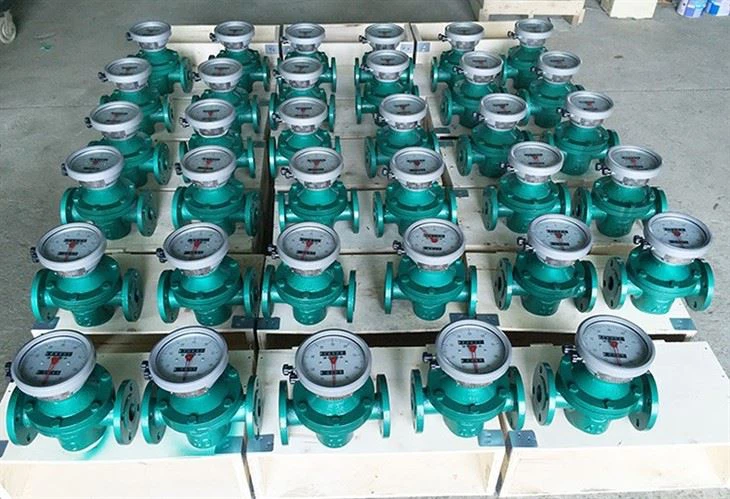
Oval Gear Flowmeters are positive displacement flowmeters. They work by trapping a fixed volume of fluid between two rotating oval gears and then counting the number of these volumes that pass through the meter. One of the key advantages of Oval Gear Flowmeters is their relatively low energy consumption.
Unlike some flowmeters that rely on external power to generate fields or operate complex electronics, Oval Gear Flowmeters are self - actuated. The flow of the fluid itself provides the energy to rotate the oval gears. This means that in most cases, they do not require an external power source for the basic flow measurement function.
However, in some applications where the flow rate needs to be displayed, transmitted, or integrated with a control system, additional electronics may be added. These electronics, such as a digital display or a transmitter, do consume a small amount of power. But compared to other flowmeters that need continuous power for their core measurement principle, the overall energy consumption of Oval Gear Flowmeters remains relatively low.
For example, in a simple diesel fuel measurement application, an Oval Gear Flow Meter For Diesel can operate without external power for the gear rotation. The only power consumption would come from any attached display or communication device, which is typically a fraction of what other flowmeters with more complex operating principles would require.
Comparison with Other Flowmeters
-
Energy Efficiency in Low - Flow Applications
In low - flow applications, Oval Gear Flowmeters have a significant advantage in terms of energy consumption. Orifice plate flowmeters can cause a large pressure drop even at low flow rates, which requires more energy to maintain the flow. Magnetic flowmeters need to generate a magnetic field continuously, and the power consumption doesn't decrease proportionally with the flow rate. Turbine flowmeters may have issues with low - flow detection and may require more power to maintain accurate measurement at low flow rates.
Oval Gear Flowmeters, on the other hand, can accurately measure low flow rates with minimal energy input. The self - actuated nature of the gears allows them to operate efficiently even when the flow is slow, making them an ideal choice for applications where energy conservation is crucial at low flow conditions. -
Energy Consumption in High - Viscosity Fluids
When dealing with high - viscosity fluids, such as diesel oil, Oval Gear Flowmeters for Diesel Oil are highly efficient. Orifice plate flowmeters may face challenges in accurately measuring high - viscosity fluids and may cause excessive pressure loss, leading to increased energy consumption. Magnetic flowmeters may also have limitations as the conductivity of high - viscosity fluids can be affected.
Oval Gear Flowmeters can handle high - viscosity fluids well because the positive displacement principle is less affected by fluid viscosity. The energy required to move the gears through the viscous fluid is relatively stable and can be much lower compared to other flowmeters that may struggle with the flow characteristics of high - viscosity fluids. -
Power Requirements for Signal Processing and Transmission
Many modern flowmeters are equipped with advanced electronics for signal processing, data logging, and communication. While Oval Gear Flowmeters also offer these features, the base energy consumption of the flow measurement mechanism is much lower. For example, a turbine flowmeter may need a significant amount of power to process the high - speed rotation signals and transmit them accurately. A magnetic flowmeter's electronics need to continuously monitor and adjust the magnetic field and process the induced voltage signals.
Oval Gear Flowmeters, once the basic flow measurement is done by the gears, require less power for signal processing because the signal is more straightforward. The number of gear rotations is directly proportional to the volume of fluid passed, simplifying the signal processing and reducing the overall energy consumption associated with the electronics.
Environmental and Cost Benefits of Low Energy Consumption
The low energy consumption of Oval Gear Flowmeters has both environmental and cost - saving benefits. From an environmental perspective, less energy consumption means a reduced carbon footprint. In industries where large - scale fluid flow measurement is required, the cumulative energy savings from using Oval Gear Flowmeters can be substantial.
In terms of cost, lower energy consumption translates into lower operating costs. Over the long term, the savings on electricity bills can be significant, especially in applications where flowmeters are operating continuously. Additionally, the reduced energy requirements can also lead to lower maintenance costs as there is less wear and tear on the power - related components.
Conclusion and Call to Action
In conclusion, Oval Gear Flowmeters offer a distinct advantage in terms of energy consumption compared to other types of flowmeters. Their self - actuated operation, efficiency in low - flow and high - viscosity applications, and relatively low power requirements for signal processing make them an energy - efficient choice for a wide range of industries.
If you're looking for a flowmeter that can provide accurate measurement while keeping energy costs down, our Oval Gear Flowmeters are an excellent option. Whether you need to measure diesel fuel or other fluids, our products are designed to meet your specific requirements. Contact us to discuss your flow measurement needs and explore how our Oval Gear Flowmeters can benefit your operations. We're ready to assist you in finding the best solution for your business.

References
- "Flow Measurement Handbook: Industrial Designs and Applications" by Richard W. Miller
- "Process Flow Measurement" by Robert W. Miller
- Technical literature from various flowmeter manufacturers.


