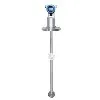
Hey there! As a flowmeter supplier, I often get asked about how different types of flowmeters work. Today, I'm gonna dive into the nitty - gritty of how a strain gauge flowmeter works.

First off, let's understand what a strain gauge flowmeter is used for. In industrial processes, measuring the flow rate of fluids (liquids or gases) is super important. Whether it's in a chemical plant, an oil refinery, or a water treatment facility, accurate flow measurement helps ensure that operations run smoothly and efficiently.
So, what's a strain gauge? Well, a strain gauge is a device that measures strain (the deformation of an object) caused by an applied force. It's usually made of a thin wire or a foil pattern that's attached to a surface. When the surface is deformed, the shape of the wire or foil changes, which in turn changes its electrical resistance.
In a strain gauge flowmeter, the basic principle is to use the force exerted by the flowing fluid to cause a strain on a sensing element. There are a few different ways this can be done, but one common method is by using a bluff body.
A bluff body is an object that's placed in the path of the flowing fluid. When the fluid flows around the bluff body, it creates a pressure difference on either side of the body. This pressure difference causes a force to act on the bluff body, and this force is proportional to the square of the flow velocity of the fluid.
Let's break this down a bit more. The fluid flowing past the bluff body creates a wake on the downstream side. The pressure in the wake is lower than the pressure on the upstream side of the bluff body. This pressure difference, ΔP, can be related to the flow velocity, v, using the Bernoulli's equation (sort of, with some simplifications for this application). The force, F, acting on the bluff body due to this pressure difference is given by F = C * ρ * A * v², where C is a coefficient that depends on the shape of the bluff body, ρ is the density of the fluid, and A is the cross - sectional area of the bluff body exposed to the fluid.
Now, here's where the strain gauge comes in. The bluff body is connected to a structure that has strain gauges attached to it. When the force acts on the bluff body, the structure deforms slightly, and this deformation is measured by the strain gauges. The strain gauges convert the mechanical strain into an electrical signal (a change in resistance).
The electrical signal from the strain gauges is then sent to a signal conditioning circuit. This circuit amplifies the weak signal from the strain gauges and converts it into a more usable form. For example, it might convert the change in resistance into a voltage or a current signal.
After the signal is conditioned, it's sent to a flow computer or a controller. The flow computer uses the relationship between the force on the bluff body (measured by the strain gauges) and the flow velocity to calculate the flow rate of the fluid. It takes into account factors like the density of the fluid, the shape of the bluff body, and the calibration of the strain gauge system.
One of the great things about strain gauge flowmeters is their versatility. They can be used to measure the flow of a wide range of fluids, from clean water to viscous oils and even some corrosive chemicals. They also have a relatively wide turndown ratio, which means they can accurately measure flow rates over a large range.
Another advantage is that they are relatively simple in design compared to some other types of flowmeters. There are no moving parts in the fluid stream (except for the slight deformation of the bluff body and the associated structure), which reduces the risk of mechanical failure and wear.
However, like any technology, strain gauge flowmeters also have some limitations. They are sensitive to changes in fluid density. If the density of the fluid changes significantly, it can affect the accuracy of the flow measurement. Also, they can be affected by vibrations in the piping system, which can cause false strain readings.
Now, when it comes to integrating a strain gauge flowmeter into a larger system, you might need a reliable pressure transmitter. That's where the Rosemount 3051C Smart Pressure Transmitter comes in handy. This transmitter can accurately measure the pressure differences in the system and work in tandem with the strain gauge flowmeter to provide more accurate flow measurements.
If you're in the market for a flowmeter, whether it's a strain gauge flowmeter or another type, I'm here to help. I've got extensive experience in supplying high - quality flowmeters for various industrial applications. We can work together to find the best solution for your specific needs, taking into account factors like the type of fluid, the flow rate range, and the environmental conditions.
If you're interested in learning more about our flowmeters or want to discuss a potential purchase, don't hesitate to reach out. I'm always happy to have a chat and see how we can help you optimize your flow measurement processes.
References:
- Principles of Fluid Mechanics textbooks
- Technical literature on flow measurement devices