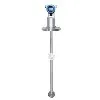
Hey everyone! I'm working for a Fork Level Switch supplier, and I often get asked by customers whether a Fork Level Switch can be connected to a control panel. So, I thought I'd write this blog to share my insights on this topic.


Let's first understand what a Fork Level Switch is. A Fork Level Switch, also known as a tuning fork level switch, is a device used to detect the level of liquids or solids in a container. It works based on the principle of the piezoelectric effect. Inside the switch, there's a fork that vibrates at its natural frequency. When the fork comes into contact with the material being measured, its vibration frequency changes. This change is then detected by the sensor, which sends a signal indicating the presence or absence of the material. You can learn more about it here: Fork Level Switch
Now, onto the main question: Can a Fork Level Switch be connected to a control panel? The answer is a resounding yes! Connecting a Fork Level Switch to a control panel is not only possible but also quite common in industrial applications.
Why Connect a Fork Level Switch to a Control Panel?
There are several reasons why you might want to connect a Fork Level Switch to a control panel. Firstly, it allows for centralized monitoring and control. In a large industrial facility, there could be multiple Fork Level Switches installed in different tanks or containers. By connecting them to a control panel, operators can monitor the level of all these containers from a single location. This saves time and effort and also reduces the risk of errors.
Secondly, a control panel can provide additional functionality such as alarm settings. You can set the control panel to trigger an alarm when the level in a container reaches a certain point. This could be a high-level alarm to prevent overfilling or a low-level alarm to avoid running out of material.
How to Connect a Fork Level Switch to a Control Panel
Connecting a Fork Level Switch to a control panel is a relatively straightforward process, but it does require some basic knowledge of electrical wiring. Here are the general steps:
- Check the Compatibility: Before you start connecting anything, make sure that the Fork Level Switch and the control panel are compatible. Check the voltage requirements, the type of output signal (e.g., relay output, transistor output), and the communication protocol (if applicable).
- Prepare the Wiring: You'll need to use appropriate cables to connect the Fork Level Switch to the control panel. Make sure the cables are rated for the voltage and current requirements of the system.
- Connect the Power Supply: Connect the power supply to the Fork Level Switch. This is usually a DC power supply, but it can vary depending on the model.
- Connect the Output Signal: Connect the output signal from the Fork Level Switch to the control panel. This could be a simple on/off signal or a more complex analog or digital signal.
- Configure the Control Panel: Once the physical connections are made, you'll need to configure the control panel to recognize the Fork Level Switch. This may involve setting up the input channels, calibration settings, and alarm thresholds.
If you're not comfortable doing the wiring yourself, it's always a good idea to hire a qualified electrician to do it for you.
Types of Fork Level Switches and Their Compatibility with Control Panels
There are different types of Fork Level Switches available in the market, and their compatibility with control panels can vary. One popular type is the Compact Tuning Fork Level Switch. This type of switch is small in size and is suitable for applications where space is limited. It usually comes with a simple relay output, which makes it easy to connect to a control panel.
Other types of Fork Level Switches may have more advanced features such as analog output or digital communication protocols like Modbus. These switches can provide more detailed information about the level of the material, but they may require more complex configuration on the control panel.
Challenges and Considerations
While connecting a Fork Level Switch to a control panel is generally a straightforward process, there are some challenges and considerations that you need to keep in mind.
One challenge is electromagnetic interference (EMI). In an industrial environment, there can be a lot of electrical equipment that generates electromagnetic fields. These fields can interfere with the signal from the Fork Level Switch, causing inaccurate readings or false alarms. To minimize EMI, you can use shielded cables, install the switch and the control panel in a grounded enclosure, and keep the cables away from other electrical equipment.
Another consideration is the environmental conditions. Fork Level Switches are designed to work in a wide range of temperatures, pressures, and chemical environments. However, extreme conditions can affect the performance of the switch and the control panel. Make sure to choose a switch and a control panel that are suitable for the specific environmental conditions of your application.
Conclusion
In conclusion, a Fork Level Switch can definitely be connected to a control panel. It offers many benefits such as centralized monitoring, alarm settings, and additional functionality. By following the proper steps and considering the challenges and considerations, you can ensure a successful connection.
If you're interested in purchasing Fork Level Switches or need more information about their connection to control panels, feel free to reach out to us. We're here to help you find the right solution for your application.
References
- Principles of Level Measurement, Instrumentation Handbook
- Industrial Switching Devices and Their Applications, Electrical Engineering Journal