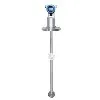
Hey there! As a flowmeter supplier, I often get asked if a flowmeter can be used to measure the flow of cryogenic fluids. Well, the short answer is yes, but there are some important things to consider. In this blog post, I'll break down the ins and outs of using flowmeters for cryogenic fluid measurement, and share some insights based on my experience in the industry.
First off, let's talk about what cryogenic fluids are. Cryogenic fluids are substances that are kept at extremely low temperatures, typically below -150°C (-238°F). Common examples include liquid nitrogen, liquid oxygen, and liquefied natural gas (LNG). These fluids are used in a wide range of applications, from medical and scientific research to industrial processes and energy storage.
Now, when it comes to measuring the flow of cryogenic fluids, there are a few challenges that need to be addressed. One of the main issues is the extreme temperature. Cryogenic fluids can cause materials to contract and become brittle, which can affect the performance and accuracy of flowmeters. Additionally, the low temperature can also lead to the formation of ice or frost on the flowmeter components, which can interfere with the measurement.
Another challenge is the properties of cryogenic fluids themselves. Many cryogenic fluids are highly volatile and have low viscosities, which can make them difficult to measure accurately. For example, liquid nitrogen has a very low density and a high vapor pressure, which means that it can easily evaporate and form bubbles. These bubbles can cause errors in the flow measurement and affect the performance of the flowmeter.
So, how do we overcome these challenges? Well, the key is to choose the right type of flowmeter for the application. There are several types of flowmeters that are suitable for measuring the flow of cryogenic fluids, including:

- Coriolis flowmeters: Coriolis flowmeters are based on the principle of the Coriolis effect, which is the deflection of a moving object due to the rotation of the Earth. In a Coriolis flowmeter, the fluid is passed through a vibrating tube, and the Coriolis force causes the tube to twist. The amount of twist is proportional to the mass flow rate of the fluid, which can be measured and used to calculate the flow rate. Coriolis flowmeters are highly accurate and can measure a wide range of fluids, including cryogenic fluids.
- Ultrasonic flowmeters: Ultrasonic flowmeters use ultrasonic waves to measure the flow rate of a fluid. There are two main types of ultrasonic flowmeters: transit-time and Doppler. Transit-time ultrasonic flowmeters measure the difference in the time it takes for ultrasonic waves to travel upstream and downstream in the fluid. The difference in time is proportional to the flow rate of the fluid. Doppler ultrasonic flowmeters measure the frequency shift of ultrasonic waves reflected off particles or bubbles in the fluid. The frequency shift is proportional to the flow rate of the fluid. Ultrasonic flowmeters are non-invasive and can be used to measure the flow of a wide range of fluids, including cryogenic fluids.
- Differential pressure flowmeters: Differential pressure flowmeters measure the difference in pressure between two points in a pipe. The difference in pressure is proportional to the flow rate of the fluid. There are several types of differential pressure flowmeters, including orifice plates, venturi tubes, and flow nozzles. Differential pressure flowmeters are relatively simple and inexpensive, but they can be affected by changes in the fluid properties and the flow profile.
In addition to choosing the right type of flowmeter, it's also important to ensure that the flowmeter is properly installed and calibrated. The flowmeter should be installed in a location where the flow is stable and free from turbulence. The flowmeter should also be calibrated using a known flow rate to ensure accurate measurement.
Now, let's talk about some of the benefits of using flowmeters to measure the flow of cryogenic fluids. One of the main benefits is improved process control. By accurately measuring the flow rate of cryogenic fluids, operators can ensure that the correct amount of fluid is being used in the process. This can help to improve the efficiency and quality of the process, as well as reduce waste and costs.
Another benefit is safety. Cryogenic fluids can be extremely dangerous if not handled properly. By accurately measuring the flow rate of cryogenic fluids, operators can ensure that the fluid is being transferred and stored safely. This can help to prevent accidents and injuries, as well as protect the environment.
Finally, let's talk about some of the applications of flowmeters for cryogenic fluid measurement. Flowmeters are used in a wide range of applications, including:
- Medical and scientific research: Cryogenic fluids are used in a variety of medical and scientific research applications, such as cryosurgery, cryopreservation, and particle physics. Flowmeters are used to measure the flow rate of cryogenic fluids in these applications to ensure accurate and precise control.
- Industrial processes: Cryogenic fluids are used in a variety of industrial processes, such as food processing, chemical manufacturing, and metalworking. Flowmeters are used to measure the flow rate of cryogenic fluids in these applications to ensure efficient and safe operation.
- Energy storage: Cryogenic fluids are used in energy storage applications, such as liquefied natural gas (LNG) storage and transportation. Flowmeters are used to measure the flow rate of cryogenic fluids in these applications to ensure accurate and efficient transfer and storage.
In conclusion, a flowmeter can be used to measure the flow of cryogenic fluids, but it's important to choose the right type of flowmeter for the application and ensure that it is properly installed and calibrated. By using flowmeters to measure the flow rate of cryogenic fluids, operators can improve process control, enhance safety, and increase efficiency. If you're interested in learning more about flowmeters for cryogenic fluid measurement, or if you have any questions or concerns, please don't hesitate to contact us. We'd be happy to help you find the right flowmeter for your application.
If you're looking for a high-quality flowmeter for your cryogenic fluid measurement needs, I'd like to recommend the Rosemount 3051C Smart Pressure Transmitter. This transmitter is designed to provide accurate and reliable pressure measurement in a variety of applications, including cryogenic fluid measurement. It features a high-performance sensor, advanced signal processing technology, and a rugged design that can withstand the harsh conditions of cryogenic environments.
If you're interested in learning more about the Rosemount 3051C Smart Pressure Transmitter, or if you have any other questions or concerns about flowmeters for cryogenic fluid measurement, please don't hesitate to contact us. We're here to help you find the right solution for your needs.
References
- "Flow Measurement Handbook: Industrial Designs and Applications" by Richard W. Miller
- "Cryogenic Engineering" by Timothy T. Gardner and Larry K. Walker
- "Ultrasonic Flowmeters: Principles and Applications" by John W. King and John A. Reeder