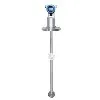
Hey there! I'm a supplier of Ultrasonic Level Meter, and today I'm gonna break down the signal processing algorithm of an ultrasonic level meter. It's a pretty cool topic that's essential for anyone looking to understand how these devices work and why they're so useful in various industries.
How Ultrasonic Level Meters Work
Before we dive into the signal processing algorithm, let's quickly go over how an ultrasonic level meter actually functions. These meters use ultrasonic waves to measure the distance between the sensor and the surface of a liquid or solid material in a tank or container. The basic principle is simple: the sensor emits an ultrasonic pulse, which travels through the air (or other medium) and bounces off the surface of the material. The sensor then receives the reflected pulse, and the time it takes for the pulse to travel to the surface and back is measured. Based on the speed of sound in the medium, the distance to the surface can be calculated.
But it's not as straightforward as it sounds. There are a lot of factors that can affect the accuracy of the measurement, such as temperature, humidity, air turbulence, and the presence of obstacles or foam on the surface of the material. That's where the signal processing algorithm comes in.
The Signal Processing Algorithm
The signal processing algorithm of an ultrasonic level meter is designed to analyze the received ultrasonic signal and extract the relevant information to calculate the distance to the surface accurately. Here are the main steps involved in the process:
1. Signal Acquisition
The first step is to acquire the ultrasonic signal from the sensor. The sensor converts the mechanical vibrations of the ultrasonic waves into an electrical signal, which is then amplified and digitized by the meter's electronics. The digitized signal is a series of discrete samples that represent the amplitude of the ultrasonic wave over time.
2. Noise Filtering
The acquired signal is usually contaminated with noise, which can come from various sources such as electrical interference, background noise, or reflections from nearby objects. To improve the signal-to-noise ratio (SNR), the signal processing algorithm applies a noise filtering technique. There are several types of filters that can be used, such as low-pass filters, high-pass filters, and band-pass filters. The choice of filter depends on the characteristics of the noise and the frequency range of the ultrasonic signal.
3. Echo Detection
Once the noise has been filtered, the next step is to detect the echo signal, which corresponds to the reflection of the ultrasonic pulse from the surface of the material. The echo signal is usually a short burst of high-amplitude signal that appears after a certain time delay from the transmission of the ultrasonic pulse. The signal processing algorithm uses various techniques to detect the echo signal, such as threshold detection, peak detection, and correlation analysis.
4. Time-of-Flight Measurement
After the echo signal has been detected, the next step is to measure the time-of-flight (TOF) of the ultrasonic pulse, which is the time it takes for the pulse to travel from the sensor to the surface and back. The TOF is usually measured by counting the number of samples between the transmission of the ultrasonic pulse and the detection of the echo signal. The accuracy of the TOF measurement depends on the sampling rate of the digitized signal and the resolution of the time counter.


5. Distance Calculation
Once the TOF has been measured, the distance to the surface can be calculated using the following formula:
[d = \frac{c \times t}{2}]
where (d) is the distance to the surface, (c) is the speed of sound in the medium, and (t) is the TOF. The speed of sound in the medium depends on the temperature, pressure, and humidity of the air (or other medium). To compensate for the effect of temperature on the speed of sound, the ultrasonic level meter usually has a built-in temperature sensor that measures the temperature of the medium and adjusts the speed of sound accordingly.
6. Level Calculation
Finally, the level of the liquid or solid material in the tank or container can be calculated by subtracting the distance to the surface from the total height of the tank or container. The level measurement can be displayed on the meter's screen or transmitted to a control system or data logger for further processing.
Advanced Signal Processing Techniques
In addition to the basic signal processing steps described above, modern ultrasonic level meters often use advanced signal processing techniques to improve the accuracy and reliability of the measurement. Here are some examples of advanced signal processing techniques:
1. Multiple Echo Detection
In some applications, there may be multiple reflections of the ultrasonic pulse from the surface of the material or from other objects in the tank or container. To improve the accuracy of the measurement, the signal processing algorithm can detect and analyze multiple echoes and select the most reliable one for the distance calculation.
2. Adaptive Filtering
The characteristics of the noise and the ultrasonic signal can vary depending on the operating conditions and the environment. To adapt to these changes, the signal processing algorithm can use adaptive filtering techniques that adjust the filter parameters based on the characteristics of the input signal.
3. Waveform Analysis
The shape and characteristics of the ultrasonic waveform can provide valuable information about the properties of the material being measured. To extract this information, the signal processing algorithm can use waveform analysis techniques such as Fourier analysis, wavelet analysis, and pattern recognition.
4. Self-Calibration
To ensure the accuracy and reliability of the measurement over time, the ultrasonic level meter can use self-calibration techniques that periodically check and adjust the calibration parameters based on the known properties of the tank or container and the material being measured.
Why the Signal Processing Algorithm Matters
The signal processing algorithm is the heart of an ultrasonic level meter. It determines the accuracy, reliability, and performance of the meter in various applications. A well-designed signal processing algorithm can compensate for the effects of noise, temperature, humidity, and other factors that can affect the measurement, and provide accurate and reliable level measurements even in challenging environments.
In addition, the signal processing algorithm can also provide valuable information about the properties of the material being measured, such as its density, viscosity, and surface roughness. This information can be used to optimize the process control and improve the efficiency and productivity of the industrial processes.
Contact Us for Your Ultrasonic Level Meter Needs
If you're in the market for an ultrasonic level meter, we're here to help. As a leading supplier of Ultrasonic Level Meter, we offer a wide range of high-quality products that are designed to meet the needs of various industries. Our meters are equipped with advanced signal processing algorithms that provide accurate and reliable level measurements even in challenging environments.
Whether you need a meter for a small tank or a large industrial process, we have the expertise and experience to help you find the right solution. Contact us today to learn more about our products and services, and to discuss your specific requirements. We look forward to working with you!
References
- Kinsler, L. E., Frey, A. R., Coppens, A. B., & Sanders, J. V. (2000). Fundamentals of Acoustics. Wiley.
- Oppenheim, A. V., & Schafer, R. W. (1999). Discrete-Time Signal Processing. Prentice Hall.
- Proakis, J. G., & Manolakis, D. G. (2006). Digital Signal Processing: Principles, Algorithms, and Applications. Pearson.