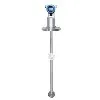
As a supplier of Roots Flowmeters, I've witnessed firsthand the critical role these devices play in accurately measuring gas flow across various industries. One persistent challenge that often arises in gas flow measurement is gas pulsation, and understanding its effect on the measurement accuracy of a Roots Flowmeter is crucial for ensuring reliable and precise data.
Understanding Gas Pulsation
Gas pulsation refers to the periodic variation in gas pressure and flow rate within a pipeline. It can be caused by a variety of factors, including the operation of reciprocating compressors, pumps, or engines. These mechanical devices introduce pulsatile flow patterns as they alternately compress and release gas, creating waves of high and low pressure that travel through the pipeline.
In industrial settings, gas pulsation is a common occurrence, especially in systems where gas is being compressed or transferred. For example, in natural gas processing plants, reciprocating compressors are used to increase the pressure of the gas for transportation. The operation of these compressors generates significant pulsations that can affect the performance of flow measurement devices downstream.
How Roots Flowmeters Work
Before delving into the effects of gas pulsation on Roots Flowmeters, it's essential to understand how these flowmeters operate. A Gas Roots Flowmeter is a positive displacement flowmeter that measures the volume of gas flowing through a pipeline by trapping and counting discrete volumes of gas.
The basic principle of a Roots Flowmeter involves two counter-rotating rotors with lobes that mesh together. As gas enters the flowmeter, it fills the spaces between the lobes and the housing. The rotation of the rotors causes the trapped gas to be carried from the inlet to the outlet of the flowmeter. Each revolution of the rotors corresponds to a specific volume of gas, and by counting the number of revolutions, the flowmeter can accurately determine the total volume of gas that has passed through.
Effects of Gas Pulsation on Measurement Accuracy
Gas pulsation can have several detrimental effects on the measurement accuracy of a Roots Flowmeter for Gas. These effects can be broadly categorized into mechanical and measurement-related issues.
Mechanical Effects
- Vibration and Wear: Gas pulsations can cause the rotors and other internal components of the flowmeter to vibrate. Over time, this vibration can lead to increased wear and tear on the components, reducing their lifespan and potentially causing mechanical failures. Excessive vibration can also loosen connections and fasteners, leading to leaks and inaccurate measurements.
- Sealing Issues: The pulsatile flow can disrupt the sealing between the rotors and the housing. This can result in gas leakage past the rotors, causing the flowmeter to under-measure the actual volume of gas flowing through the pipeline. Sealing problems can also lead to increased friction between the components, further exacerbating the wear and reducing the measurement accuracy.
Measurement-Related Effects
- Flow Disturbance: Gas pulsations can create turbulent flow patterns within the flowmeter. Turbulence can cause the gas to flow unevenly around the rotors, leading to inaccurate volume measurements. The irregular flow can also cause the rotors to rotate at inconsistent speeds, introducing errors in the counting mechanism of the flowmeter.
- Pressure Fluctuations: Pulsatile pressure variations can affect the performance of the flowmeter's pressure sensors. These sensors are used to compensate for changes in gas density and pressure, which are essential for accurate volume measurement. When the pressure fluctuates rapidly due to gas pulsation, the sensors may not be able to respond quickly enough, resulting in inaccurate density and pressure readings and, consequently, inaccurate flow measurements.
Mitigating the Effects of Gas Pulsation
To minimize the impact of gas pulsation on the measurement accuracy of a Gas Flowmeter, several strategies can be employed.
Pulsation Dampeners
One of the most effective ways to reduce gas pulsation is to install pulsation dampeners in the pipeline upstream of the flowmeter. Pulsation dampeners are devices that absorb and dissipate the energy of the pulsatile waves, smoothing out the flow and reducing the amplitude of the pressure variations. These dampeners can be in the form of surge tanks, accumulators, or pulsation absorbers, depending on the specific application and requirements.
Proper Installation and Sizing
Ensuring proper installation and sizing of the flowmeter is also crucial for minimizing the effects of gas pulsation. The flowmeter should be installed in a location where the flow is as stable as possible, away from sources of pulsation such as compressors or pumps. Additionally, the flowmeter should be sized correctly for the expected flow rate and pressure conditions to ensure optimal performance.
Advanced Signal Processing
Many modern Roots Flowmeters are equipped with advanced signal processing algorithms that can compensate for the effects of gas pulsation. These algorithms analyze the signals from the flowmeter's sensors and apply mathematical models to correct for the errors introduced by pulsatile flow. By using advanced signal processing, the flowmeter can provide more accurate and reliable measurements even in the presence of gas pulsation.
Importance of Accurate Gas Flow Measurement
Accurate gas flow measurement is essential for a variety of reasons, especially in industries where gas is a valuable commodity or where precise control of gas flow is required for process optimization.


In the energy sector, for example, accurate measurement of natural gas flow is crucial for billing purposes. Gas producers and distributors rely on accurate flow measurements to determine the amount of gas being sold or purchased, ensuring fair and accurate transactions. In addition, accurate flow measurement is necessary for monitoring and controlling the efficiency of gas production and transportation processes.
In industrial processes, such as chemical manufacturing and power generation, precise control of gas flow is essential for maintaining product quality and process safety. Incorrect gas flow measurements can lead to under- or over-feeding of reactants, resulting in product quality issues or even safety hazards.
Conclusion
Gas pulsation can have a significant impact on the measurement accuracy of a Roots Flowmeter. The mechanical and measurement-related effects of gas pulsation can lead to increased wear, sealing issues, flow disturbances, and inaccurate pressure readings, all of which can compromise the reliability and precision of the flow measurements. However, by implementing appropriate mitigation strategies such as using pulsation dampeners, ensuring proper installation and sizing, and utilizing advanced signal processing, these effects can be minimized.
As a supplier of Roots Flowmeters, we understand the importance of providing our customers with accurate and reliable flow measurement solutions. Our flowmeters are designed to withstand the challenges posed by gas pulsation and deliver precise measurements even in demanding applications. If you are facing issues with gas pulsation in your gas flow measurement system or are looking for a high-quality Roots Flowmeter for your application, we encourage you to contact us for a detailed consultation. Our team of experts can help you select the right flowmeter and implement the necessary measures to ensure accurate and reliable gas flow measurement.
References
- ISO 5167-1:2018, Measurement of fluid flow by means of pressure differential devices inserted in circular cross-section conduits running full - Part 1: General principles and requirements.
- API MPMS Chapter 5.6, Measurement of Natural Gas by Rotary Gas Meters.
- Flow Measurement Handbook: Principles and Practice of Flow Measurement, by Richard W. Miller.