When it comes to measuring fluid flow, two common types of flowmeters are full - bore and insertion flowmeters. As a flowmeter supplier, I've encountered numerous inquiries about the differences between these two types of devices. In this blog post, I'll explain the distinctions in design, installation, performance, and applications to help you make an informed decision when choosing the right flowmeter for your needs.
Design
The most fundamental difference between full - bore and insertion flowmeters lies in their design. A full - bore flowmeter is designed to be installed as an integral part of the pipeline. It has a measuring tube that spans the entire cross - section of the pipe, and the fluid flows directly through this tube. The measuring principle, whether it's electromagnetic, ultrasonic, or Coriolis, is applied across the entire flow area of the pipe.
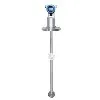
On the other hand, an insertion flowmeter is a device that is inserted into the pipeline through a small opening. It doesn't replace the pipe but rather protrudes into the fluid stream at a specific point. Insertion flowmeters can be based on various technologies such as thermal, vortex, or ultrasonic, and they measure the flow at a single point or a limited area within the pipe.
Installation
Installation is another area where full - bore and insertion flowmeters differ significantly. Installing a full - bore flowmeter is a more complex and time - consuming process. It often requires cutting the pipeline and installing flanges or other connection methods to integrate the flowmeter into the system. This means that there will be a significant downtime for the pipeline during installation, especially in large - scale industrial applications. Additionally, proper alignment and calibration are crucial to ensure accurate measurements, which further adds to the installation complexity.
In contrast, insertion flowmeters are relatively easy to install. They can be inserted into the pipeline through a pre - drilled hole or a fitting, and in many cases, this can be done without shutting down the entire system. This makes insertion flowmeters a great option for applications where minimizing downtime is a priority. For example, in a water distribution network, an insertion flowmeter can be quickly installed to monitor the flow in a particular section without disrupting the water supply to consumers.
Performance
The performance characteristics of full - bore and insertion flowmeters also vary. Full - bore flowmeters generally offer higher accuracy because they measure the flow across the entire cross - section of the pipe. This provides a more representative measurement of the total flow rate, especially in applications where the flow profile is complex or non - uniform. They are also less affected by changes in the flow profile due to factors such as bends, valves, or other pipeline components.
Insertion flowmeters, however, are more sensitive to the flow profile at the point of insertion. If the flow is not fully developed or is turbulent at the insertion point, the measurement accuracy can be compromised. To mitigate this issue, insertion flowmeters often require a certain length of straight pipe upstream and downstream of the insertion point to ensure a stable flow profile. Despite these limitations, insertion flowmeters can still provide reasonably accurate measurements in applications where the flow is relatively uniform and the installation location can be carefully selected.
Applications
The choice between a full - bore and an insertion flowmeter also depends on the specific application. Full - bore flowmeters are commonly used in applications where high accuracy and reliability are required, such as in chemical processing plants, oil and gas refineries, and food and beverage industries. In these industries, precise flow measurement is essential for process control, quality assurance, and custody transfer.
Insertion flowmeters are more suitable for applications where cost - effectiveness, ease of installation, and flexibility are important. They are often used in water and wastewater treatment plants, HVAC systems, and irrigation systems. For example, in a large - scale irrigation project, insertion flowmeters can be used to monitor the flow in multiple sections of the irrigation network at a relatively low cost.
Cost Considerations
Cost is an important factor in the decision - making process. Full - bore flowmeters are generally more expensive than insertion flowmeters. The cost of the flowmeter itself is higher, and the installation costs are also significant due to the need for pipeline modification and complex installation procedures. However, in applications where high accuracy is critical, the long - term benefits of using a full - bore flowmeter may outweigh the initial investment.
Insertion flowmeters, on the other hand, are more cost - effective in terms of both the device cost and installation cost. They are a great option for applications where a lower - cost solution is required, especially when the accuracy requirements are not as stringent.

Compatibility with Other Devices
In modern industrial settings, flowmeters often need to be integrated with other devices such as Rosemount 3051C Smart Pressure Transmitter for comprehensive process control. Full - bore flowmeters can be more easily integrated into a complete measurement and control system because they are designed as a part of the pipeline. Their outputs can be directly connected to other devices for data logging, analysis, and control.
Insertion flowmeters may require additional adapters or signal conditioning to be compatible with other devices. However, with the advancement of technology, many insertion flowmeters now come with standard communication protocols that make integration easier.
Maintenance
Maintenance requirements also differ between full - bore and insertion flowmeters. Full - bore flowmeters may require more extensive maintenance due to their complex design and integration into the pipeline. Regular calibration and inspection are necessary to ensure accurate measurements, and in case of a malfunction, the entire flowmeter may need to be removed from the pipeline for repair or replacement.
Insertion flowmeters are generally easier to maintain. They can be easily removed for cleaning or calibration without shutting down the entire pipeline. In some cases, the sensing element of an insertion flowmeter can be replaced without removing the entire device, which reduces maintenance time and cost.
In conclusion, both full - bore and insertion flowmeters have their own advantages and disadvantages. The choice between them depends on a variety of factors, including accuracy requirements, installation constraints, cost, application type, and maintenance considerations. As a flowmeter supplier, I can help you evaluate your specific needs and recommend the most suitable flowmeter for your application. If you're interested in learning more about our flowmeter products or have any questions about the selection process, please don't hesitate to contact us for a detailed discussion and procurement negotiation.
References
- "Flow Measurement Handbook: Industrial Designs and Applications" by Ralph W. Miller.
- "Process Instrumentation and Control Handbook" by Bela G. Liptak.
- Technical documentation from various flowmeter manufacturers.