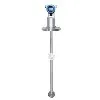
As a seasoned supplier of Vortex Flowmeters, I've encountered numerous inquiries from customers regarding the optimal length of the straight pipe section for these devices. This topic is crucial as it directly impacts the accuracy and reliability of flow measurements. In this blog post, I'll delve into the factors influencing the required straight pipe length and provide some practical guidelines.
The Importance of Straight Pipe Sections in Vortex Flowmeters
Vortex Flowmeters operate on the principle of the von Kármán vortex street. When a fluid flows past a bluff body (also known as a shedder bar) installed in the pipeline, vortices are alternately shed from either side of the bluff body. The frequency of these vortex shedding is directly proportional to the fluid velocity, which allows the flowmeter to measure the flow rate.
However, the formation and stability of the von Kármán vortex street are highly sensitive to the flow profile. Any disturbances in the flow, such as swirls, eddies, or uneven velocity distributions, can disrupt the vortex shedding pattern and lead to inaccurate measurements. This is where the straight pipe section comes into play. A sufficient length of straight pipe upstream and downstream of the flowmeter helps to straighten the flow, eliminate disturbances, and ensure a stable and uniform flow profile at the measurement point.


Factors Affecting the Required Straight Pipe Length
Several factors influence the optimal length of the straight pipe section for a Vortex Flowmeter. These include:
1. Upstream Pipe Fittings
The type and configuration of upstream pipe fittings have a significant impact on the flow profile and, consequently, the required straight pipe length. For example, elbows, tees, valves, and reducers can all introduce swirls and eddies into the flow. The more complex the upstream piping layout, the longer the straight pipe section needed to allow the flow to recover and become fully developed.
- Elbows: A single 90-degree elbow typically requires a minimum of 15 to 20 pipe diameters of straight pipe upstream of the flowmeter. Multiple elbows in different planes or close proximity may require even longer straight pipe lengths, up to 40 pipe diameters or more.
- Tees: A tee can cause significant flow disturbances, especially if the flow is split or combined. A minimum of 20 to 30 pipe diameters of straight pipe upstream is usually recommended for a tee.
- Valves: Partially open valves can create severe flow disturbances. Depending on the valve type and degree of opening, a straight pipe length of 20 to 50 pipe diameters or more may be required upstream of the flowmeter.
2. Flow Conditions
The flow rate, fluid viscosity, and Reynolds number also affect the required straight pipe length. Higher flow rates and lower viscosities generally result in more turbulent flows, which require longer straight pipe sections to stabilize. The Reynolds number, which is a dimensionless parameter that characterizes the flow regime (laminar or turbulent), can be used to estimate the required straight pipe length more accurately.
3. Flowmeter Design
Different Vortex Flowmeter designs may have different requirements for the straight pipe length. Some flowmeters are more tolerant of flow disturbances than others, thanks to advanced sensor technologies and signal processing algorithms. Manufacturers usually provide specific guidelines for the minimum straight pipe lengths based on their flowmeter models.
General Guidelines for Straight Pipe Length
Based on industry standards and best practices, the following are some general guidelines for the straight pipe length requirements for Vortex Flowmeters:
Upstream Straight Pipe Length
- For a simple piping layout with no significant upstream disturbances (e.g., a straight run of pipe with no fittings): A minimum of 10 to 15 pipe diameters of straight pipe upstream of the flowmeter is usually sufficient.
- For a single 90-degree elbow upstream: A minimum of 15 to 20 pipe diameters of straight pipe is recommended.
- For multiple elbows or complex upstream piping configurations: A minimum of 20 to 40 pipe diameters or more of straight pipe may be required.
Downstream Straight Pipe Length
A minimum of 5 to 10 pipe diameters of straight pipe downstream of the flowmeter is generally recommended to ensure a stable flow profile and accurate measurement.
It's important to note that these are just general guidelines, and the actual straight pipe length requirements may vary depending on the specific application and flow conditions. In some cases, flow conditioning devices such as flow straighteners or swirl eliminators can be used to reduce the required straight pipe length.
Practical Considerations
When installing a Vortex Flowmeter, it's essential to consider the following practical aspects:
1. Space Constraints
In some industrial settings, space may be limited, making it challenging to provide the recommended straight pipe lengths. In such cases, flow conditioning devices can be a viable solution. However, it's important to ensure that the flow conditioning device is properly selected and installed to achieve the desired flow straightening effect.
2. Cost
Longer straight pipe sections require more piping material and installation space, which can increase the overall cost of the installation. Therefore, it's necessary to strike a balance between the required straight pipe length and the cost of the installation.
3. Maintenance
Adequate access to the straight pipe sections and the flowmeter is essential for maintenance and inspection. Make sure there is enough space around the flowmeter to allow for easy removal and reinstallation during maintenance activities.
Our Vortex Flowmeter Solutions
At our company, we offer a wide range of high-quality Vortex Flowmeters, including the Temperature And Pressure Compensate Vortex Flowmeter, Hot Oil Flowmeter, and LUGB Vortex Flowmeter. Our flowmeters are designed with advanced technologies to provide accurate and reliable flow measurements even in challenging applications.
We understand the importance of the straight pipe length for the performance of Vortex Flowmeters, and our technical experts can provide customized solutions based on your specific application requirements. Whether you need a simple flow measurement solution or a complex system with flow conditioning devices, we have the expertise and experience to meet your needs.
Conclusion
The length of the straight pipe section is a critical factor in ensuring the accuracy and reliability of Vortex Flowmeter measurements. By understanding the factors that affect the required straight pipe length and following the general guidelines, you can optimize the installation of your flowmeter and achieve accurate and consistent flow measurements.
If you have any questions or need further assistance with your Vortex Flowmeter installation, please don't hesitate to contact us. Our team of experts is ready to help you select the right flowmeter and provide the necessary support for a successful installation. We look forward to the opportunity to discuss your specific requirements and work with you to find the best solution for your flow measurement needs.
References
- ISO 5167-1:2003, Measurement of fluid flow by means of pressure differential devices inserted in circular cross-section conduits running full - Part 1: General principles and requirements.
- AGA Report No. 3, Orifice Metering of Natural Gas and Other Related Hydrocarbon Fluids.
- Manufacturer's installation and operation manuals for Vortex Flowmeters.