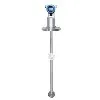
Hey there! As a supplier of Roots Flowmeters, I often get asked about how these nifty devices perform in dirty gas environments. Well, let's dive right in and explore this topic.
First off, what exactly is a Roots Flowmeter? A Gas Roots Flowmeter is a positive displacement flowmeter that measures the volume of gas flowing through it. It works by trapping a fixed volume of gas between two rotating rotors and then counting the number of rotations. This method provides a pretty accurate measurement of the gas flow.
Now, when it comes to dirty gas environments, things can get a bit tricky. Dirty gas usually contains various contaminants like dust, dirt, oil, and even some chemical particles. These contaminants can potentially affect the performance of any flowmeter, and the Roots Flowmeter is no exception.
One of the main concerns in a dirty gas environment is the build - up of contaminants on the rotors of the Roots Flowmeter. The rotors need to rotate smoothly to ensure accurate measurement. If dust or dirt accumulates on them, it can cause increased friction. This increased friction can slow down the rotation of the rotors, leading to inaccurate flow measurements. The flowmeter might start to under - report the actual gas flow, which can be a big problem in industries where precise measurement is crucial, like in the natural gas distribution or chemical processing.


Another issue is the potential damage to the internal components of the Roots Flowmeter for Gas. Some of the contaminants in dirty gas, especially chemical particles, can be corrosive. Over time, these corrosive substances can eat away at the surfaces of the rotors and other internal parts. This not only affects the accuracy of the flowmeter but also reduces its lifespan. If the internal components are severely damaged, the flowmeter might need to be replaced, which can be a costly affair.
However, don't be too quick to write off the Roots Flowmeter in dirty gas environments. At our company, we've taken several steps to make our Roots Flowmeters more resilient. For starters, we use high - quality materials for the rotors and other internal components. These materials are more resistant to wear and corrosion, which helps to extend the life of the flowmeter even in harsh conditions.
We also incorporate advanced filtration systems in our Gas Flowmeter. These filtration systems are designed to trap the larger contaminants before they reach the internal components of the flowmeter. By removing the bulk of the dirt and dust, the filtration system reduces the chances of build - up on the rotors and other parts. This not only helps to maintain the accuracy of the flowmeter but also reduces the need for frequent maintenance.
In addition to filtration, we've also optimized the design of the flowmeter to make it easier to clean. The internal parts are designed in such a way that they can be easily accessed and cleaned when necessary. This means that even if some contaminants do manage to get past the filtration system, it's not too difficult to keep the flowmeter in good working condition.
Let's talk about some real - world examples. In the oil and gas industry, there are often dirty gas streams that need to be measured. Our Roots Flowmeters have been used in many oil and gas fields around the world. Despite the presence of dirt, sand, and other contaminants in the gas, our flowmeters have been able to provide reliable and accurate measurements. The high - quality materials and the effective filtration systems have helped to keep the flowmeters running smoothly for long periods of time.
Another industry where our Roots Flowmeters have proven their worth is the chemical industry. Chemical processes often involve the use of gases that can be dirty and corrosive. Our flowmeters have been able to withstand the harsh chemical environments and continue to provide accurate flow measurements. This has helped our customers to optimize their processes and improve their overall efficiency.
Of course, like any piece of equipment, the Roots Flowmeter does require some maintenance in dirty gas environments. Regular inspections are necessary to check for any signs of wear or build - up. The filtration systems need to be cleaned or replaced periodically to ensure that they are working effectively. But compared to some other types of flowmeters, the maintenance requirements of our Roots Flowmeters are relatively low.
So, in conclusion, while dirty gas environments do pose some challenges for the Roots Flowmeter, with the right design and features, it can perform very well. Our high - quality materials, advanced filtration systems, and user - friendly design make our Roots Flowmeters a great choice for measuring gas flow in dirty environments.
If you're in an industry that deals with dirty gas and you're looking for a reliable flowmeter, we'd love to hear from you. Whether you need a flowmeter for a small - scale operation or a large industrial plant, we have the right solution for you. Contact us to start a discussion about your specific requirements and how our Roots Flowmeters can meet them. Let's work together to ensure accurate and efficient gas flow measurement in your operations.
References
- Flow Measurement Handbook: Industrial Designs and Applications, Third Edition by Richard W. Miller
- Principles of Flow Measurement by Robert W. Miller