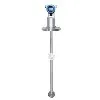
Hey there! As a supplier of Ultrasonic Level Meters, I've had my fair share of experiences and questions from customers. One common query that often pops up is how the presence of vapor affects an Ultrasonic Level Meter. So, let's dive right into it and explore this topic in detail.
First off, let's understand what an Ultrasonic Level Meter does. It's a nifty device that uses ultrasonic waves to measure the level of a liquid or solid in a tank or container. The meter sends out ultrasonic pulses, and when these pulses hit the surface of the material being measured, they bounce back to the meter. By measuring the time it takes for the pulses to return, the meter can calculate the distance to the surface and thus determine the level.
Now, let's talk about vapor. Vapor is essentially a gaseous form of a substance that is usually in a liquid or solid state at normal conditions. In industrial settings, you can find vapor in tanks where there are volatile liquids, or in environments with high humidity. So, how does this vapor mess with our Ultrasonic Level Meter?
One of the main ways vapor affects the meter is by absorbing and scattering the ultrasonic waves. When the ultrasonic pulses travel through the vapor, some of the energy in the waves gets absorbed by the vapor molecules. This means that by the time the pulses reach the surface of the material and bounce back, they have less energy. As a result, the meter might receive a weaker signal, which can lead to inaccurate readings.


For example, if you're using an Ultrasonic Level Meter to measure the level of a volatile liquid in a tank, and there's a lot of vapor above the liquid surface, the meter might think that the distance to the surface is greater than it actually is. This is because the weaker signal takes longer to travel back to the meter, making it seem like the surface is farther away.
Another issue is scattering. Vapor can cause the ultrasonic waves to scatter in different directions. Instead of traveling in a straight line towards the surface and back, the waves might bounce off in various directions due to the vapor particles. This scattering can make it difficult for the meter to pick up the reflected signal properly. In some cases, the scattered waves might even interfere with each other, creating a lot of noise in the signal. This noise can make it hard for the meter to distinguish between the true reflected signal and the background noise, leading to errors in the level measurement.
The density and composition of the vapor also play a crucial role. Different types of vapor have different absorption and scattering properties. For instance, if the vapor is made up of heavier molecules, it's more likely to absorb and scatter the ultrasonic waves more effectively than a vapor with lighter molecules. So, if you're dealing with a vapor that has a high density or is made up of large, heavy molecules, the impact on the Ultrasonic Level Meter readings will be more significant.
Temperature and pressure can also affect how vapor impacts the meter. Higher temperatures generally mean that the vapor molecules have more energy and are more spread out. This can change the way the vapor absorbs and scatters the ultrasonic waves. Similarly, changes in pressure can alter the density of the vapor, which in turn affects the signal transmission.
So, what can we do to minimize these effects? Well, one solution is to use a higher-powered Ultrasonic Level Meter. A meter with a more powerful transmitter can send out stronger ultrasonic pulses. Even if some of the energy is absorbed by the vapor, there's still enough energy left in the pulses to get a decent signal back. However, this isn't a foolproof solution, as there are limits to how much power you can use, and higher power might also increase the cost of the meter.
Another option is to install the meter in a way that reduces its exposure to the vapor. For example, you can use a stilling well. A stilling well is a tube that is placed inside the tank, and the Ultrasonic Level Meter is installed at the top of the well. The well helps to isolate the meter from the vapor and other disturbances in the tank. It allows the ultrasonic waves to travel through a more stable environment, reducing the chances of signal loss and interference.
You can also try to control the vapor in the tank. This could involve using ventilation systems to remove the vapor from the tank or using cooling systems to condense the vapor back into a liquid. By reducing the amount of vapor in the tank, you can improve the accuracy of the Ultrasonic Level Meter readings.
In some cases, you might need to calibrate the meter specifically for the presence of vapor. This involves taking into account the absorption and scattering properties of the vapor in the calibration process. By doing this, you can adjust the meter's settings to compensate for the effects of the vapor and get more accurate readings.
Now, I know dealing with vapor and getting accurate level measurements can be a real headache. But that's where our Ultrasonic Level Meters come in. We've designed our meters to be as reliable as possible, even in challenging environments with vapor. Our team of experts has worked hard to develop advanced signal processing algorithms that can help filter out the noise caused by vapor and improve the accuracy of the readings.
If you're facing issues with vapor affecting your level measurements, or if you're just looking for a high - quality Ultrasonic Level Meter that can handle vapor conditions, don't hesitate to get in touch with us. We're here to help you find the best solution for your specific needs. Whether you're in the chemical industry, food and beverage industry, or any other industry that requires accurate level measurements, we've got you covered.
In conclusion, the presence of vapor can have a significant impact on the performance of an Ultrasonic Level Meter. It can cause signal attenuation, scattering, and interference, all of which can lead to inaccurate level measurements. However, with the right techniques and equipment, you can minimize these effects and get reliable readings. So, if you're in the market for an Ultrasonic Level Meter that can stand up to vapor challenges, give us a shout. We're eager to start a conversation and help you solve your level measurement problems.
References
- "Ultrasonic Measurement Technology" - A textbook on the principles and applications of ultrasonic measurement devices.
- Industry research papers on the effects of vapor on ultrasonic sensors.