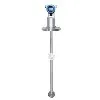
Temperature is a crucial environmental factor that can significantly influence the performance of ultrasonic flowmeters. As a leading supplier of ultrasonic flowmeters, we have in - depth knowledge and extensive experience in understanding how temperature impacts these devices. This blog post aims to explore the various ways temperature affects ultrasonic flowmeters, including the principles behind these effects and how we, as a supplier, address these challenges to ensure accurate and reliable measurements.
Basic Principles of Ultrasonic Flowmeters
Before delving into the impact of temperature, it's essential to understand the basic working principles of ultrasonic flowmeters. Ultrasonic flowmeters measure the flow rate of a fluid by using ultrasonic waves. There are two main types: transit - time and Doppler.
In transit - time flowmeters, ultrasonic signals are sent in both the upstream and downstream directions of the fluid flow. The difference in the transit times of the ultrasonic waves traveling upstream and downstream is proportional to the flow velocity of the fluid. The flow rate can then be calculated based on the cross - sectional area of the pipe and the measured flow velocity.
Doppler flowmeters, on the other hand, rely on the Doppler effect. They emit ultrasonic waves into the fluid, and the waves are reflected by particles or bubbles in the fluid. The frequency shift of the reflected waves is used to determine the flow velocity.
Effects of Temperature on Ultrasonic Flowmeters
1. Speed of Sound in the Fluid
The speed of sound in a fluid is highly dependent on temperature. According to the kinetic theory of gases and the physical properties of liquids, the speed of sound (c) in a fluid can be expressed by different equations. For an ideal gas, the speed of sound is given by (c=\sqrt{\gamma RT/M}), where (\gamma) is the adiabatic index, (R) is the universal gas constant, (T) is the absolute temperature, and (M) is the molar mass of the gas. In liquids, the speed of sound also increases with an increase in temperature, although the relationship is more complex and depends on the specific properties of the liquid.


In ultrasonic flowmeters, the transit - time measurement is based on the speed of sound in the fluid. A change in temperature will cause a change in the speed of sound, which in turn affects the measured transit times. If the temperature change is not compensated for, it can lead to significant errors in the flow rate measurement. For example, in a transit - time ultrasonic flowmeter, an increase in temperature will increase the speed of sound in the fluid. This will cause the transit times of the ultrasonic waves to change, and if the flowmeter's algorithm does not account for this change, it may over - or under - estimate the flow rate.
2. Thermal Expansion of the Pipe
The pipe in which the fluid is flowing also experiences thermal expansion or contraction with temperature changes. The dimensions of the pipe, such as the inner diameter and the length between the ultrasonic transducers, will change. In a transit - time ultrasonic flowmeter, the distance between the transducers is a critical parameter for calculating the flow rate. A change in the pipe's dimensions due to thermal expansion can lead to errors in the flow rate measurement.
For instance, if the pipe expands due to an increase in temperature, the distance between the transducers increases. This will affect the transit times of the ultrasonic waves, and if not compensated for, will result in inaccurate flow rate calculations.
3. Performance of Ultrasonic Transducers
Ultrasonic transducers are key components of ultrasonic flowmeters. Temperature can have a significant impact on their performance. The piezoelectric materials used in ultrasonic transducers have temperature - dependent properties. As the temperature changes, the resonance frequency of the piezoelectric element may shift, which can affect the efficiency of the transducer in generating and receiving ultrasonic waves.
A change in temperature can also cause changes in the damping characteristics of the transducer. This can lead to a decrease in the signal - to - noise ratio, making it more difficult for the flowmeter to accurately detect and process the ultrasonic signals. In extreme cases, high temperatures can even damage the transducer, leading to complete failure of the flowmeter.
Our Solutions as a Supplier
1. Temperature Compensation Algorithms
To address the issue of the temperature - dependent speed of sound in the fluid, we have developed advanced temperature compensation algorithms. These algorithms continuously monitor the temperature of the fluid and adjust the flow rate calculations accordingly. By measuring the temperature of the fluid using integrated temperature sensors, the flowmeter can accurately calculate the speed of sound at the current temperature and use this value in the transit - time calculations. This ensures that the flow rate measurement remains accurate even when the temperature of the fluid changes.
2. Pipe Material and Installation Considerations
When installing our ultrasonic flowmeters, we take into account the thermal expansion properties of the pipe material. We provide detailed installation guidelines to ensure that the flowmeter is installed in a way that minimizes the impact of pipe expansion or contraction on the flow rate measurement. For example, we recommend using appropriate mounting techniques and allowing for some flexibility in the installation to accommodate the thermal expansion of the pipe.
3. High - Temperature - Resistant Transducers
We use high - quality, high - temperature - resistant piezoelectric materials in our ultrasonic transducers. These materials have a more stable performance over a wide temperature range, reducing the impact of temperature on the resonance frequency and damping characteristics of the transducers. This helps to maintain a high signal - to - noise ratio and ensures reliable operation of the flowmeter even in high - temperature environments.
Our Product Range
We offer a wide range of ultrasonic flowmeters to meet the diverse needs of our customers. Our Split Type Open Channel Flowmeter is suitable for measuring the flow rate in open channels. It is designed to be highly accurate and reliable, even in challenging environmental conditions. Our Clamp On Ultrasonic Flowmeter is non - invasive, which means it can be easily installed on existing pipes without the need for pipe cutting or modification. This makes it a cost - effective solution for many applications. And our Ultrasonic Water Meter is specifically designed for measuring the flow rate of water, with high accuracy and long - term stability.
Contact Us for Purchase and Consultation
If you are interested in our ultrasonic flowmeters or have any questions about how temperature affects their performance, please feel free to contact us. Our team of experts is ready to provide you with detailed product information, technical support, and assistance in selecting the most suitable flowmeter for your application. We are committed to providing high - quality products and excellent customer service to ensure that you get the best flow measurement solutions.
References
- "Flow Measurement Handbook: Industrial Designs and Applications" by Richard W. Miller.
- "Ultrasonic Flowmeters: Principles and Applications" by various authors in the field of flow measurement.
- Technical papers on the temperature effects on ultrasonic transducers and flowmeters published in relevant scientific journals.