

As a supplier of Coriolis flowmeters, I've spent a significant amount of time delving into the intricacies of these devices. One of the most common questions I encounter from customers is about the accuracy of density measurement in Coriolis flowmeters. In this blog, I'll explore this topic in depth, discussing the factors that influence accuracy, the typical accuracy levels, and how our products at [Assumed Company] ensure reliable density measurements.
Understanding Coriolis Flowmeters
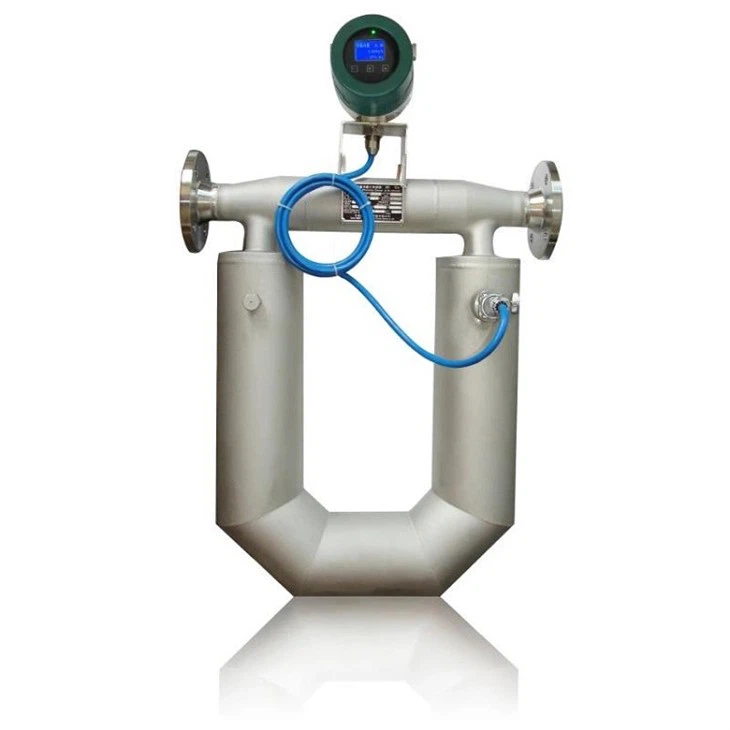
Coriolis flowmeters are based on the Coriolis effect, a physical phenomenon that describes the deflection of an object in a rotating reference frame. In a Coriolis flowmeter, fluid flows through a vibrating tube. As the fluid moves through the tube, the Coriolis force causes the tube to twist. This twist is proportional to the mass flow rate of the fluid. Additionally, the frequency of the tube's vibration is related to the density of the fluid.
Coriolis flowmeters offer several advantages over other types of flowmeters. They provide direct mass flow measurement, which is independent of fluid properties such as density, viscosity, and temperature. This makes them highly accurate and reliable for a wide range of applications. Moreover, they can also measure density and temperature simultaneously, providing a comprehensive set of data about the fluid being measured.
Factors Affecting Density Measurement Accuracy
The accuracy of density measurement in a Coriolis flowmeter can be influenced by several factors. Understanding these factors is crucial for ensuring accurate and reliable measurements.
Fluid Properties
The properties of the fluid being measured can have a significant impact on density measurement accuracy. For example, fluids with high viscosity or those containing solids or bubbles can cause the vibrating tube to dampen, affecting the frequency of vibration and thus the density measurement. Additionally, changes in fluid composition can also affect density. For instance, a change in the concentration of a dissolved substance in a liquid can alter its density.
Temperature and Pressure
Temperature and pressure can also affect the accuracy of density measurement. As the temperature of a fluid changes, its density also changes. Similarly, changes in pressure can cause the fluid to compress or expand, altering its density. Most Coriolis flowmeters are equipped with temperature and pressure sensors to compensate for these effects. However, extreme temperature and pressure conditions can still pose challenges to accurate density measurement.
Installation and Calibration
Proper installation and calibration are essential for accurate density measurement. Incorrect installation, such as improper piping or alignment, can cause mechanical stress on the vibrating tube, affecting its vibration characteristics and thus the density measurement. Additionally, regular calibration is necessary to ensure that the flowmeter is accurately measuring density. Calibration involves comparing the flowmeter's measurements to a known standard and adjusting the flowmeter accordingly.
Typical Accuracy Levels
The accuracy of density measurement in Coriolis flowmeters can vary depending on the specific model and manufacturer. Generally, high-quality Coriolis flowmeters can achieve density measurement accuracies of ±0.0005 g/cm³ to ±0.001 g/cm³. However, these accuracies can be affected by the factors mentioned above.
It's important to note that accuracy is often specified as a percentage of the measured value or as an absolute value. For example, an accuracy of ±0.1% of reading means that the measured density can deviate from the true density by up to 0.1% of the measured value. On the other hand, an absolute accuracy of ±0.001 g/cm³ means that the measured density can deviate from the true density by up to 0.001 g/cm³, regardless of the measured value.
Ensuring Accurate Density Measurement with Our Coriolis Flowmeters
At [Assumed Company], we are committed to providing high-quality Coriolis flowmeters that offer accurate and reliable density measurement. Our flowmeters are designed with advanced technology and precision engineering to minimize the effects of factors that can affect accuracy.
Advanced Sensor Technology
Our Coriolis flowmeters are equipped with state-of-the-art sensors that are highly sensitive to changes in the vibrating tube's frequency. These sensors can detect even the slightest changes in density, ensuring accurate measurement. Additionally, our sensors are designed to be resistant to the effects of temperature, pressure, and fluid properties, providing stable and reliable measurements.
Comprehensive Compensation Algorithms
To compensate for the effects of temperature and pressure, our flowmeters are equipped with comprehensive compensation algorithms. These algorithms use the data from the temperature and pressure sensors to adjust the density measurement, ensuring that it is accurate regardless of the operating conditions.
Rigorous Testing and Calibration
Before leaving our factory, each Coriolis flowmeter undergoes rigorous testing and calibration to ensure that it meets our strict quality standards. We use traceable standards and advanced calibration equipment to verify the accuracy of the density measurement. Additionally, we offer on-site calibration services to ensure that our flowmeters continue to provide accurate measurements throughout their lifespan.
Applications of Coriolis Flowmeters for Density Measurement
Coriolis flowmeters are widely used in various industries for density measurement. Some of the common applications include:
Chemical Industry
In the chemical industry, accurate density measurement is crucial for quality control and process optimization. Coriolis flowmeters are used to measure the density of various chemicals, such as acids, bases, and solvents. This information is used to ensure that the chemicals are within the desired specifications and to monitor the progress of chemical reactions.
Food and Beverage Industry
In the food and beverage industry, density measurement is used to control the quality of products such as beer, wine, and dairy products. Coriolis flowmeters can accurately measure the density of these products, which is related to their composition and quality. This information is used to ensure that the products meet the required standards and to optimize the production process.

Oil and Gas Industry
In the oil and gas industry, density measurement is used to determine the quality and quantity of oil and gas products. Coriolis flowmeters are used to measure the density of crude oil, refined products, and natural gas. This information is used for custody transfer, process control, and inventory management.
Conclusion
The accuracy of density measurement in a Coriolis flowmeter is influenced by several factors, including fluid properties, temperature and pressure, and installation and calibration. However, with advanced technology and precision engineering, high-quality Coriolis flowmeters can achieve accurate and reliable density measurement. At [Assumed Company], we are dedicated to providing our customers with the best Coriolis flowmeters that offer accurate density measurement and comprehensive data about the fluid being measured.
If you're interested in learning more about our Coriolis Flowmeter or need a reliable solution for density measurement, we encourage you to reach out to us. Our team of experts is ready to assist you in selecting the right flowmeter for your application and to provide you with the support you need to ensure accurate and reliable measurements. Whether you're in the chemical, food and beverage, or oil and gas industry, our Mass Flowmeter and Coriolis Mass Flowmeter for Drinking can meet your needs. Contact us today to start a discussion about your requirements and explore how our products can benefit your operations.
References
- Beck, M. S., & Plaskowski, A. (1987). Flow Measurement Handbook: Industrial Designs, Operating Principles, Performance, and Applications. John Wiley & Sons.
- Spitzer, D. W. (2001). Flow Measurement: Practical Guides for Measurement and Control. ISA - The Instrumentation, Systems, and Automation Society.
- Wriedt, T. (2006). Flow Measurement. Springer.


