

When it comes to measuring the level of liquids or solids in tanks, the choice of a reliable level meter is crucial. As a supplier of Ultrasonic Level Meter, I often encounter inquiries from customers about the suitability of our ultrasonic level meters for tanks with curved bottoms. In this blog post, I will delve into the technical aspects and practical considerations to answer the question: Can an ultrasonic level meter be used in a tank with a curved bottom?
How Ultrasonic Level Meters Work
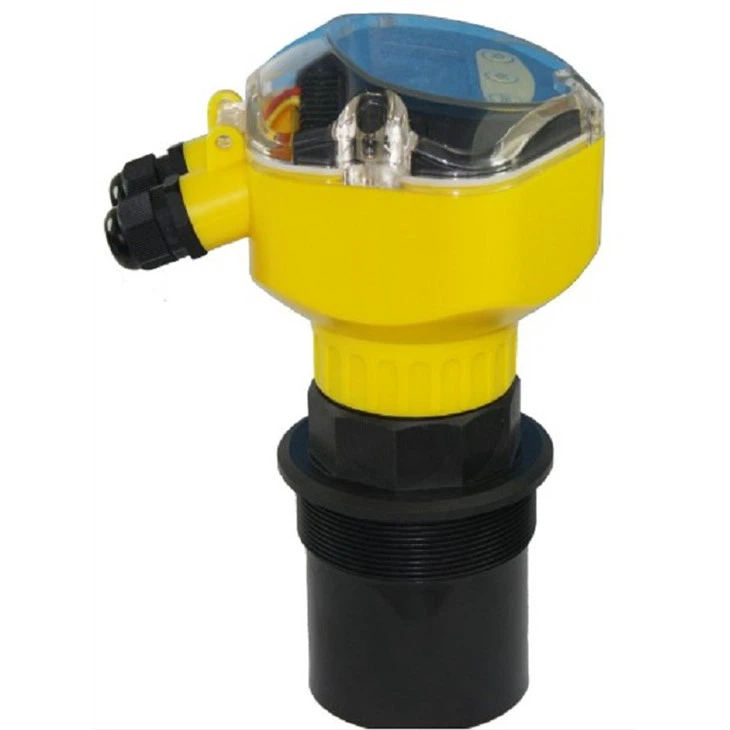
Before discussing the compatibility with curved - bottom tanks, it's essential to understand how ultrasonic level meters operate. These devices work on the principle of echolocation. An ultrasonic transducer emits high - frequency sound waves towards the surface of the liquid or solid in the tank. When these waves hit the surface, they are reflected back to the transducer. The time taken for the sound waves to travel to the surface and back is measured. Using the known speed of sound in the medium (usually air), the distance between the transducer and the surface can be calculated, and from this, the level in the tank can be determined.
Challenges Posed by Curved Bottom Tanks
Curved bottom tanks present several challenges for ultrasonic level meters. One of the main issues is the reflection pattern of the ultrasonic waves. In a tank with a flat bottom, the sound waves are reflected back in a relatively straightforward manner. However, in a curved - bottom tank, the curvature can cause the sound waves to scatter in different directions. This scattering can lead to multiple reflections and echoes, making it difficult for the transducer to accurately detect the primary reflection from the liquid or solid surface.
Another challenge is the presence of dead zones. Dead zones are areas in the tank where the ultrasonic waves cannot reach or where the reflections are too weak to be detected. In curved - bottom tanks, the shape of the curve can create dead zones near the edges or in the lower parts of the tank, which can result in inaccurate level measurements.
Factors Affecting the Use of Ultrasonic Level Meters in Curved - Bottom Tanks
Several factors need to be considered when determining whether an ultrasonic level meter can be used in a tank with a curved bottom:
1. Radius of Curvature
The radius of curvature of the tank bottom plays a significant role. A tank with a large radius of curvature (i.e., a gently curved bottom) is more likely to be compatible with an ultrasonic level meter than a tank with a small radius of curvature (a sharply curved bottom). In a tank with a large radius of curvature, the scattering of ultrasonic waves is less severe, and the primary reflection is more likely to be detected.
2. Liquid or Solid Properties
The properties of the liquid or solid being measured also affect the performance of the ultrasonic level meter. For example, if the liquid has a high viscosity or contains a lot of suspended particles, it can absorb or scatter the ultrasonic waves, reducing the accuracy of the measurement. Similarly, if the solid is powdery or has an irregular surface, it can cause problems with the reflection of the sound waves.
3. Tank Dimensions
The size of the tank is another important factor. In larger tanks, the ultrasonic waves have more space to travel, and the effects of the curved bottom may be less pronounced. However, in smaller tanks, the curvature can have a more significant impact on the reflection pattern of the waves.
Mitigating the Challenges
Despite the challenges, there are several ways to mitigate the issues associated with using an ultrasonic level meter in a curved - bottom tank:

1. Transducer Placement
Proper transducer placement is crucial. Placing the transducer at the center of the tank, directly above the highest point of the curved bottom, can help minimize the scattering of the ultrasonic waves. This way, the sound waves are more likely to be reflected back to the transducer in a direct manner.
2. Signal Processing
Advanced signal processing techniques can be used to filter out the unwanted echoes and reflections. Modern ultrasonic level meters are equipped with sophisticated algorithms that can analyze the received signals and identify the primary reflection from the liquid or solid surface. These algorithms can help improve the accuracy of the measurements in curved - bottom tanks.
3. Calibration
Calibration is essential for accurate level measurements in any tank, but it is especially important in curved - bottom tanks. During calibration, the level meter is adjusted to account for the specific characteristics of the tank, such as the radius of curvature and the presence of dead zones. This ensures that the measurements are as accurate as possible.
Case Studies
To illustrate the practical application of ultrasonic level meters in curved - bottom tanks, let's look at a few case studies:
Case Study 1: A Chemical Storage Tank
A chemical manufacturing company had a curved - bottom storage tank with a large radius of curvature. They installed an ultrasonic level meter at the center of the tank and used advanced signal processing techniques. After calibration, the level meter was able to provide accurate measurements of the chemical level in the tank, despite the curved bottom.
Case Study 2: A Grain Silo
A grain storage facility had a silo with a curved bottom. The initial installation of the ultrasonic level meter without proper calibration and transducer placement resulted in inaccurate measurements. However, after re - positioning the transducer and calibrating the meter, the accuracy of the level measurements improved significantly.
Conclusion
In conclusion, while using an ultrasonic level meter in a tank with a curved bottom presents challenges, it is possible to achieve accurate level measurements with the right approach. By considering factors such as the radius of curvature, liquid or solid properties, and tank dimensions, and by implementing proper transducer placement, signal processing, and calibration techniques, ultrasonic level meters can be effectively used in curved - bottom tanks.
If you are facing the challenge of measuring levels in a curved - bottom tank and are considering an ultrasonic level meter, I encourage you to reach out to us. Our team of experts can provide you with detailed advice and solutions tailored to your specific requirements. We are committed to helping you find the best level measurement solution for your application.
References
- "Ultrasonic Level Measurement: Principles and Applications" - Industrial Measurement Handbook
- "Challenges in Level Measurement in Non - Standard Tanks" - Journal of Instrumentation and Control Engineering


