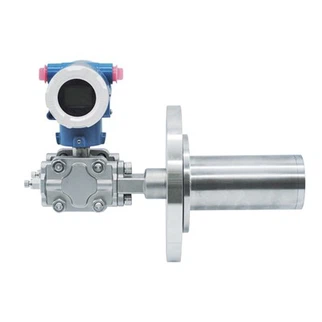
Pressure transmitters are used to measure the pressure of liquids, gases, or vapors, and then convert the pressure signal into a 4-20mA DC signal output. They are widely used in measurement and control systems for weakly corrosive liquids, gases, and vapors in industrial pipelines. The intelligent pressure transmitter consists of two parts: an intelligent sensor and an intelligent electronic board. The intelligent sensor part includes a capacitive sensor, a measuring diaphragm detection circuit, a temperature sensor, and a temperature compensation circuit
In the decompression resistance pressure transmitter, we first know the resistance Strain gauge. The resistance Strain gauge is a sensitive device that converts the strain change on the measured piece into an electrical signal. It is one of the main components of a piezoresistive strain transmitter. The most widely used resistance Strain gauge are metal resistance Strain gauge and semiconductor Strain gauge. There are two types of metal resistance Strain gauge: wire Strain gauge and metal foil Strain gauge.
Generally, the Strain gauge is tightly bonded to the matrix generating mechanical strain through special adhesive. When the stress of the matrix changes, the resistance Strain gauge also deforms together, changing the resistance of the Strain gauge, thus changing the voltage applied to the resistance. The two pressures of the tested medium in the pressure transmitter are introduced into the high and low pressure chambers, which act on the δ On both sides of the isolation diaphragm of the component (i.e. sensitive component), the filling liquid inside the component is transmitted to both sides of the measurement diaphragm through the isolation diaphragm. Measure the membrane and the electrodes on both sides of the insulation sheet to form a capacitor.
When the pressure on both sides is inconsistent, it causes displacement of the measuring diaphragm. The displacement is proportional to the pressure difference, so the capacitance on both sides is unequal. Through oscillation and demodulation, it is converted into a signal proportional to the pressure. The working principle of pressure transmitters and absolute pressure transmitters is the same as that of differential pressure transmitters, except that the low-pressure chamber pressure is either atmospheric pressure or vacuum.