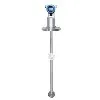
A transit-time ultrasonic flowmeter is a sophisticated device used for measuring the flow rate of liquids in pipes. As a leading supplier of ultrasonic flowmeters, I am excited to delve into the working principle of this remarkable technology.
Basic Concept of Transit - Time Ultrasonic Flowmeter
The fundamental concept behind a transit - time ultrasonic flowmeter is based on the difference in the time it takes for ultrasonic signals to travel upstream and downstream in a flowing fluid. Ultrasonic waves are high - frequency sound waves that are inaudible to the human ear. When these waves are transmitted through a fluid, their propagation speed is affected by the flow velocity of the fluid.
Let's consider a simple scenario where we have a pipe with a flowing liquid. Two ultrasonic transducers are installed on the outside of the pipe at a certain angle to the direction of the flow. One transducer acts as a transmitter, and the other as a receiver. The transducers can switch their roles, allowing for the measurement of both the upstream and downstream transit times.
Upstream and Downstream Transit Time Measurement
When the ultrasonic wave is transmitted in the direction of the fluid flow (downstream), the wave is carried along by the flowing fluid, and its effective velocity is the sum of the ultrasonic wave's velocity in the stationary fluid ($c$) and the component of the fluid's velocity ($v$) in the direction of the wave propagation. If the distance between the two transducers is $L$, and the angle between the path of the ultrasonic wave and the direction of the pipe axis is $\theta$, the downstream transit time $t_d$ can be calculated using the following formula:
[t_d=\frac{L}{c + v\cos\theta}]
Conversely, when the ultrasonic wave is transmitted against the direction of the fluid flow (upstream), the wave has to travel against the flow, and its effective velocity is the difference between the ultrasonic wave's velocity in the stationary fluid and the component of the fluid's velocity in the direction of the wave propagation. The upstream transit time $t_u$ is given by:
[t_u=\frac{L}{c - v\cos\theta}]
Calculation of Fluid Flow Velocity
The difference between the upstream and downstream transit times ($\Delta t=t_u - t_d$) is related to the fluid flow velocity. By substituting the expressions for $t_u$ and $t_d$ and simplifying the equation, we can obtain the following relationship:
[\Delta t=\frac{2Lv\cos\theta}{c^{2}-v^{2}\cos^{2}\theta}]
In most practical applications, the velocity of the ultrasonic wave in the fluid ($c$) is much larger than the fluid flow velocity ($v$), so $v^{2}\cos^{2}\theta$ can be neglected compared to $c^{2}$. Then the equation simplifies to:
[\Delta t\approx\frac{2Lv\cos\theta}{c^{2}}]
From this equation, we can solve for the fluid flow velocity $v$:
[v=\frac{c^{2}\Delta t}{2L\cos\theta}]
Once the fluid flow velocity $v$ is known, the volumetric flow rate $Q$ can be calculated by multiplying the cross - sectional area of the pipe $A$ by the average flow velocity. For a circular pipe of diameter $D$, the cross - sectional area $A=\frac{\pi D^{2}}{4}$. So, $Q = A\times v$.
Advantages of Transit - Time Ultrasonic Flowmeters
One of the significant advantages of transit - time ultrasonic flowmeters is their non - invasive nature. Non Invasive Ultrasonic Flowmeters Non Invasive Ultrasonic Flowmeter can be clamped onto the outside of the pipe without the need to cut into the pipe or disrupt the flow. This makes them ideal for applications where the fluid is corrosive, abrasive, or where there are strict hygiene requirements.
Another advantage is their high accuracy. Transit - time ultrasonic flowmeters can provide accurate flow measurements over a wide range of flow rates. They are also highly reliable and have a long service life, as they have no moving parts that can wear out or break down.
Applications of Transit - Time Ultrasonic Flowmeters
Transit - time ultrasonic flowmeters are widely used in various industries. In the water and wastewater industry, they are used to measure the flow of water in pipes for distribution, treatment, and monitoring purposes. They can also be used in the oil and gas industry to measure the flow of crude oil, refined products, and natural gas.
In the industrial process control, transit - time ultrasonic flowmeters are used to monitor and control the flow of liquids in chemical processes, power plants, and food and beverage production. Handhold Ultrasonic Flowmeters Handhold Ultrasonic Flowmeter are particularly useful for temporary flow measurements and on - site inspections.
In addition, these flowmeters can be used for measuring the flow of rivers and open channels. River Flow Meters River Flow Meter are designed to accurately measure the flow rate of water in rivers, which is crucial for flood control, water resource management, and environmental monitoring.
Considerations for Using Transit - Time Ultrasonic Flowmeters
While transit - time ultrasonic flowmeters offer many advantages, there are also some considerations when using them. The accuracy of the flow measurement can be affected by factors such as the fluid's temperature, density, and viscosity. Changes in these properties can alter the velocity of the ultrasonic wave in the fluid and affect the transit time measurements.
The installation of the transducers is also critical. The transducers must be installed at the correct position and angle to ensure accurate measurement. Any misalignment or incorrect installation can lead to significant errors in the flow measurement.
Conclusion
In conclusion, the working principle of a transit - time ultrasonic flowmeter is based on the difference in the transit times of ultrasonic waves traveling upstream and downstream in a flowing fluid. This technology offers a non - invasive, accurate, and reliable method for measuring the flow rate of liquids in pipes.
As a supplier of ultrasonic flowmeters, we are committed to providing high - quality products that meet the diverse needs of our customers. Whether you need a non - invasive flowmeter for a corrosive fluid application, a handhold flowmeter for on - site inspections, or a river flow meter for water resource management, we have the right solution for you.


If you are interested in our ultrasonic flowmeters or have any questions about their application, please feel free to contact us for further discussion and procurement. We look forward to working with you to meet your flow measurement requirements.
References
- "Flow Measurement Handbook: Industrial Designs and Applications" by Richard W. Miller.
- "Ultrasonic Flowmeters: Principles and Applications" by various authors, published in industry - specific technical journals.