

Hey there! As a supplier of Liquid Density Meters, I often get asked about the measuring principle of a hydrostatic liquid density meter. So, I thought I'd take a moment to break it down for you in a way that's easy to understand.
First off, let's talk about what density is. Density is basically how much mass is packed into a certain volume. In the case of liquids, it tells us how heavy a liquid is for its size. And a hydrostatic liquid density meter is a nifty device that helps us figure out this density.
The core idea behind the hydrostatic measuring principle is based on Archimedes' principle. You know, that famous story about Archimedes jumping out of his bath and shouting "Eureka!" Well, his principle states that when an object is submerged in a fluid (like a liquid), it experiences an upward buoyant force equal to the weight of the fluid it displaces.
In a hydrostatic liquid density meter, there's usually a sensing element that gets submerged in the liquid we want to measure. This sensing element can be a float or a tube, for example. When it's in the liquid, the buoyant force acting on it changes depending on the density of the liquid.
Let's say we have a simple float-type hydrostatic density meter. The float is designed to have a certain volume and mass. When it's placed in a liquid, it sinks until the buoyant force acting on it balances out its weight. If the liquid is denser, it'll displace more weight of the liquid for the same volume of the float, and the float will sit higher in the liquid. On the other hand, if the liquid is less dense, the float will sink a bit more.
We can measure the position of the float or the change in the force acting on it. This measurement is then converted into a density value. Modern hydrostatic density meters use advanced sensors and electronics to make this conversion very accurate.
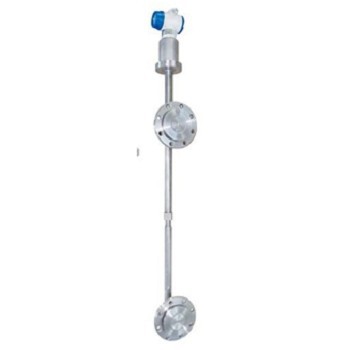

For instance, some density meters use pressure sensors. The pressure at a certain depth in a liquid is related to the density of the liquid and the depth. By measuring the pressure difference between two points at different depths in the liquid, we can calculate the density. If the pressure difference is large, it means the liquid is denser because there's more weight of the liquid above the lower point.
Now, let me tell you a bit about the different types of density meters we offer at our company. We have the Online Density Transmitter, which is great for continuous monitoring of density in industrial processes. It can send real-time density data to a control system, allowing for quick adjustments if needed.
Our Liquid Density Meter is a more general-purpose device. It can be used in various applications, from laboratories to chemical plants. It's easy to operate and gives accurate density measurements for different types of liquids.
And if you're dealing with slurries, we have the Slurry Density Meter. Measuring the density of slurries can be tricky because of the presence of solid particles. But our slurry density meter is designed to handle these challenges and provide reliable density readings.
The hydrostatic measuring principle has a lot of advantages. It's relatively simple and doesn't require a lot of moving parts, which means less maintenance. It's also quite accurate and can work over a wide range of densities. And because it relies on physical principles, it's not affected by the chemical properties of the liquid too much, as long as the sensing element is compatible with the liquid.
However, like any technology, it has its limitations. For example, changes in temperature can affect the density of the liquid and also the performance of the density meter. That's why many of our density meters come with temperature compensation features to make sure the readings are accurate even when the temperature varies.
Another limitation is that very viscous liquids can sometimes cause issues. The sensing element might not be able to move freely in a highly viscous liquid, which can affect the accuracy of the measurement. But we've designed our meters to minimize these effects as much as possible.
In industrial applications, having an accurate density measurement is crucial. In the food and beverage industry, for example, density can tell us about the sugar content in a juice or the alcohol content in a beer. In the chemical industry, it can help in quality control, ensuring that the right chemical reactions are taking place. And in oil and gas, density measurements are used to determine the quality and value of the products.
If you're in the market for a density meter and wondering which one is right for you, we're here to help. Our team of experts can look at your specific requirements, such as the type of liquid you're measuring, the range of densities, the operating conditions, and recommend the best solution for you.
Whether you're a small lab looking for a basic density measurement tool or a large industrial plant in need of a sophisticated online density monitoring system, we've got you covered. We've been in the business for a while, and we know how important it is to have reliable and accurate density meters.
So, if you're interested in learning more about our Online Density Transmitter, Liquid Density Meter, or Slurry Density Meter, or if you just have some questions about the measuring principle or anything else related to density meters, don't hesitate to reach out. We're happy to have a chat and see how we can help you with your density measurement needs.
References:
- Principles of Fluid Mechanics textbooks
- Industry standards and guidelines for density measurement


