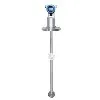
Hey there! I'm working as a supplier for concentration meters, and I often get asked about how these nifty devices work. Today, I wanna dig deep into the measurement principle of a radiofrequency - based concentration meter.
Let's start with the basics. Radiofrequency (RF) technology has been around for a while, and it's found its way into all sorts of applications, including concentration measurement. So, what's the big deal about using RF for measuring concentration? Well, it offers a non - invasive and highly accurate way to figure out the concentration of substances in a solution.
The fundamental idea behind an RF - based concentration meter is that different substances have different dielectric properties. Dielectric properties describe how a material responds to an electric field. When an RF signal is sent through a solution, the interaction between the RF field and the solution depends on the dielectric constant of the substances present in the solution.
Think of it like this: imagine you're sending a radio wave through a room filled with different objects. Each object will interact with the radio wave in its own way, depending on its size, shape, and material. Similarly, in a solution, different substances will interact with the RF signal based on their dielectric constants.
The RF - based concentration meter typically consists of a transmitter and a receiver. The transmitter generates an RF signal and sends it through the solution. As the signal passes through the solution, it gets modified based on the concentration of the substances in it. The receiver then picks up this modified signal and analyzes it to determine the concentration.
One of the key components in an RF - based concentration meter is the sensor. The sensor is designed to be in contact with the solution and to accurately measure the changes in the RF signal. It's usually made of materials that are resistant to corrosion and can withstand the chemical environment of the solution.
Now, let's talk about the advantages of using an RF - based concentration meter. First off, it's non - invasive. This means you don't have to take a sample out of the solution to measure its concentration. You can just install the meter in the pipeline or tank where the solution is flowing or stored, and it will continuously monitor the concentration in real - time. This is a huge plus in industries where continuous monitoring is crucial, like the chemical, food, and beverage industries.
Another advantage is its high accuracy. RF technology can detect very small changes in the dielectric constant, which allows for precise measurement of the concentration. This is important when you need to maintain strict quality control in your production process.
RF - based concentration meters are also very reliable. They have fewer moving parts compared to some other types of concentration meters, which means there's less chance of mechanical failure. And because they're based on electrical signals, they're less affected by environmental factors like temperature and pressure.
At our company, we offer a range of concentration meters based on RF technology. For example, we have the Tri - clamp Sanitary Concentration Transmitter. This transmitter is designed for applications where hygiene is a top priority, like in the food and beverage industry. It's easy to clean and can be installed in a sanitary pipeline system.


We also have the Online Concentration Transmitter. This transmitter is great for continuous monitoring in industrial processes. It can be connected to a control system, allowing you to remotely monitor and control the concentration of the solution.
And if you're in the drinking water industry, we have the Drinking Concentration Meter. This meter is specifically designed to measure the concentration of substances in drinking water, ensuring that the water meets the required quality standards.
So, how does the RF - based concentration meter actually measure the concentration? Well, it uses a calibration curve. Before using the meter, you need to calibrate it with solutions of known concentrations. The meter measures the RF signal for each of these known solutions and creates a calibration curve that relates the RF signal to the concentration. Once the calibration is done, the meter can then use this curve to measure the concentration of unknown solutions.
It's important to note that the accuracy of the measurement depends on the quality of the calibration. You need to make sure that the calibration solutions are prepared accurately and that the calibration process is carried out correctly.
In addition to the calibration, there are other factors that can affect the measurement. For example, the temperature of the solution can have an impact on the dielectric constant. So, most RF - based concentration meters have a built - in temperature compensation feature to correct for these effects.
Another factor is the presence of impurities in the solution. Impurities can change the dielectric properties of the solution and affect the measurement. In some cases, you may need to filter the solution or use a more advanced calibration method to account for these impurities.
Overall, RF - based concentration meters are a powerful tool for measuring the concentration of substances in a solution. They offer a non - invasive, accurate, and reliable way to monitor concentration in real - time. Whether you're in the chemical, food, beverage, or drinking water industry, these meters can help you improve the quality of your products and processes.
If you're interested in learning more about our concentration meters or if you're looking to purchase one for your business, don't hesitate to get in touch. We're here to answer all your questions and help you find the right concentration meter for your specific needs. Let's start a conversation about how we can work together to optimize your concentration measurement processes.
References
- "Principles of Radiofrequency Technology in Industrial Measurement" - A technical paper on the application of RF in measurement.
- "Non - Invasive Concentration Measurement Methods" - A research article discussing different non - invasive techniques for concentration measurement.
- "Advances in RF - Based Sensors for Chemical Analysis" - A review article on the latest developments in RF - based sensors for chemical concentration measurement.