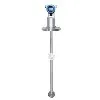
Hey there! As a supplier of concentration meters, I often get asked about how these nifty devices work. Today, I'm gonna dive deep into the measurement principle of a conductivity concentration meter.
First off, let's understand what conductivity is. Conductivity, in simple terms, is a measure of a material's ability to conduct an electric current. In the context of a concentration meter, we're usually talking about the conductivity of a liquid solution. The more ions are present in the solution, the better it conducts electricity. That's the basic idea we're gonna build on.
How Conductivity Relates to Concentration
You see, in many solutions, the concentration of a particular substance is directly related to the number of ions in the solution. For example, if you have a saltwater solution, the more salt (sodium chloride) you dissolve in the water, the more sodium and chloride ions are released into the solution. These ions act as charge carriers, allowing an electric current to flow more easily through the solution.
So, by measuring the conductivity of the solution, we can estimate the concentration of the substance of interest. This relationship is often linear over a certain range, but it can get a bit more complicated in real - world scenarios.
The Working Principle of a Conductivity Concentration Meter
A typical conductivity concentration meter consists of a conductivity sensor and a measuring circuit. The conductivity sensor is usually made up of two electrodes immersed in the solution. When an alternating current (AC) is applied to these electrodes, the ions in the solution start to move. The movement of these ions creates an electric current, and the conductivity meter measures the magnitude of this current.
The reason we use an AC current instead of a direct current (DC) is to avoid a phenomenon called polarization. Polarization can occur when a DC current is applied, causing ions to accumulate near the electrodes and altering the conductivity measurement. By using an AC current, we can prevent this from happening and get a more accurate measurement.


The measuring circuit then takes the current measurement and converts it into a conductivity value. This value is often displayed on a screen or can be transmitted to a control system.
Factors Affecting Conductivity Measurement
There are several factors that can affect the accuracy of a conductivity concentration meter. Temperature is one of the most significant factors. The conductivity of a solution generally increases with temperature because the ions move more freely at higher temperatures. Most modern conductivity meters have a built - in temperature sensor to compensate for this effect. They use a temperature coefficient to adjust the conductivity measurement based on the temperature of the solution.
The composition of the solution can also have an impact. If there are other ions present in the solution besides the ones we're interested in, they can contribute to the overall conductivity. This can make it challenging to accurately measure the concentration of a specific substance. In some cases, we may need to use more advanced techniques or calibration methods to account for these additional ions.
Different Types of Conductivity Concentration Meters
We offer a variety of conductivity concentration meters to suit different applications. One popular type is the Fork Type Concentration Meter. This type of meter has a unique fork - shaped sensor design that allows for easy installation and measurement in pipes or tanks. It's great for continuous monitoring of solution concentration in industrial processes.
Another option is the Fork Type Concentration Transmitter. This device not only measures conductivity but also converts the measurement into a standard signal, such as a 4 - 20 mA signal. This makes it easy to integrate with other control systems and transmit the concentration data over long distances.
For applications in the drinking water industry, we have the Drinking Concentration Meter. This meter is specifically designed to measure the concentration of substances like chlorine, fluoride, and other contaminants in drinking water. It's crucial for ensuring the safety and quality of our drinking water.
Calibration and Maintenance
Calibration is an essential part of using a conductivity concentration meter. Over time, the electrodes in the sensor can become dirty or worn, which can affect the accuracy of the measurement. To ensure accurate readings, it's important to calibrate the meter regularly using a standard solution with a known conductivity.
Maintenance is also key. Keeping the sensor clean and free from debris is crucial. You can use a mild cleaning solution to clean the electrodes periodically. Additionally, checking the cables and connections for any signs of damage is a good practice.
Why Choose Our Concentration Meters
As a supplier, we take pride in offering high - quality concentration meters. Our meters are designed with the latest technology to provide accurate and reliable measurements. We also offer excellent customer support, so if you have any questions or run into any issues, our team is always ready to help.
Whether you're in the chemical industry, food and beverage industry, or water treatment industry, our conductivity concentration meters can meet your needs. We understand that every application is unique, and we're committed to providing customized solutions.
Let's Connect
If you're interested in learning more about our conductivity concentration meters or if you're looking to purchase one for your business, don't hesitate to get in touch. We're here to have a chat about your specific requirements and help you find the perfect concentration meter for your needs.
References
- "Principles of Instrumental Analysis" by Douglas A. Skoog, F. James Holler, and Stanley R. Crouch
- "Handbook of Modern Sensors: Physics, Designs, and Applications" by Jacob Fraden