

As a supplier of Vortex Flowmeters, I often get asked about the maximum flow rate these devices can measure. It's a crucial question, especially for industries that rely on accurate flow measurement for their operations. In this blog, I'll dive into the factors that determine the maximum flow rate of a Vortex Flowmeter and give you a better understanding of what to expect.
First off, let's understand how a Vortex Flowmeter works. These meters operate on the principle of the von Kármán vortex street. When a fluid flows past a bluff body (also known as a shedder bar) placed in the flow path, it creates alternating vortices on either side of the bluff body. The frequency of these vortices is directly proportional to the flow velocity of the fluid. By measuring this frequency, the flowmeter can calculate the flow rate.
Now, when it comes to the maximum flow rate, several factors come into play. One of the primary factors is the size of the flowmeter. Generally, larger flowmeters can handle higher flow rates. This is because they have a larger cross - sectional area through which the fluid can pass. For example, a 6 - inch Vortex Flowmeter will typically have a higher maximum flow rate compared to a 2 - inch one.
The type of fluid being measured also matters a great deal. Different fluids have different physical properties such as density, viscosity, and compressibility. For instance, gases are less dense than liquids, and this affects how they flow through the flowmeter. A Vortex Flowmeter designed for measuring gas flow will have a different maximum flow rate compared to one designed for liquid flow. When dealing with steam, which is a compressible fluid, additional considerations are needed. You might be interested in our Steam Flowmeter, which is specifically designed to handle the unique characteristics of steam.
Another factor is the design of the bluff body. The shape and size of the bluff body can influence the formation and detection of vortices at high flow rates. A well - designed bluff body can ensure stable vortex formation even at very high velocities, allowing the flowmeter to accurately measure high flow rates.
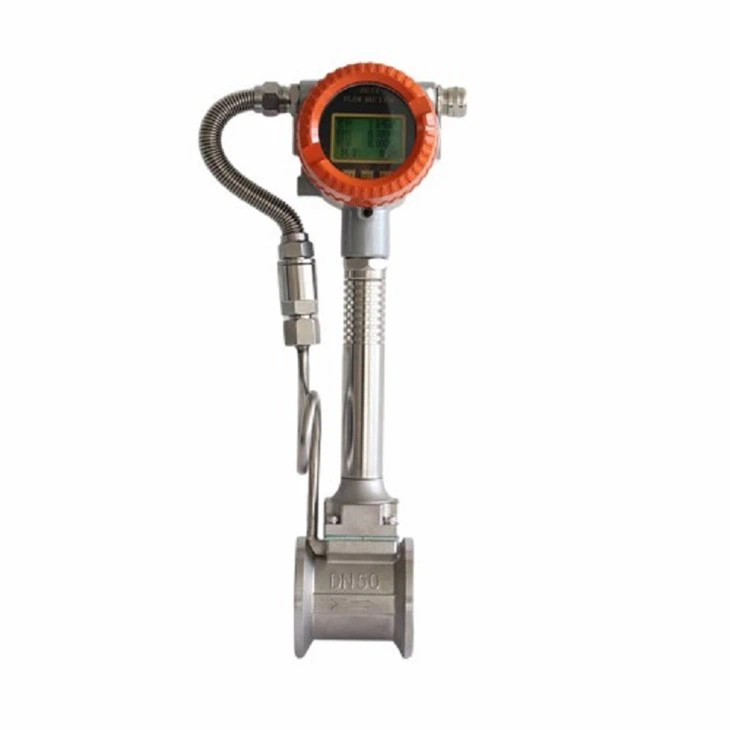
The operating conditions, such as temperature and pressure, also impact the maximum flow rate. High temperatures can cause changes in the fluid's physical properties, and high pressures can affect the structural integrity of the flowmeter components. Our Temperature And Pressure Compensate Flowmeter is an excellent solution for applications where temperature and pressure variations are significant. It can automatically adjust the flow measurement based on the changes in these parameters, ensuring accurate readings across a wide range of operating conditions.
In general, the maximum flow rate of a Vortex Flowmeter can vary widely depending on the model and application. For small - sized flowmeters used in laboratory or low - flow applications, the maximum flow rate might be in the range of a few liters per minute. On the other hand, large - scale industrial flowmeters can handle flow rates in the thousands of cubic meters per hour.
Let's take a look at some typical ranges. For liquid applications, a standard 1 - inch Vortex Flowmeter might have a maximum flow rate of around 10 - 15 cubic meters per hour. A 4 - inch flowmeter can handle up to 100 - 150 cubic meters per hour. In gas applications, a 1 - inch flowmeter could have a maximum flow rate of around 100 - 200 standard cubic meters per hour, while a 4 - inch flowmeter can reach up to 1000 - 1500 standard cubic meters per hour.
However, these are just rough estimates. To get the exact maximum flow rate for a specific application, you need to consider all the factors I've mentioned above and consult the flowmeter's technical specifications. Our team of experts can help you select the right flowmeter based on your specific requirements.
If you're looking for a compact and efficient solution, our Compact Vortex Flowmeter is a great option. It offers accurate flow measurement in a small footprint, making it suitable for applications where space is limited.
When choosing a Vortex Flowmeter, it's also important to consider the accuracy requirements of your application. At high flow rates, the accuracy of the flowmeter might decrease slightly. But with proper calibration and selection, you can still achieve the desired level of accuracy.
In conclusion, determining the maximum flow rate that a Vortex Flowmeter can measure is not a one - size - fits - all answer. It depends on multiple factors including flowmeter size, fluid type, bluff body design, and operating conditions. As a Vortex Flowmeter supplier, we have a wide range of products to meet different application needs. Whether you're in the chemical, oil and gas, or food and beverage industry, we can provide you with the right flow measurement solution.
If you're interested in learning more about our Vortex Flowmeters or have specific requirements for your project, don't hesitate to reach out. We're here to help you make the best choice for your flow measurement needs. Let's start a conversation about how our flowmeters can improve the efficiency and accuracy of your operations.

References
- "Flow Measurement Handbook: Industrial Designs and Applications" by Richard W. Miller
- Manufacturer's technical documentation for Vortex Flowmeters


