Hey there! As a supplier of Vortex Flowmeters, I often get asked about the linearity of these nifty devices. So, let's dive right in and explore what linearity means in the context of a Vortex Flowmeter.
First off, what's a Vortex Flowmeter anyway? Well, it's a type of flowmeter that measures the flow rate of a fluid (either liquid or gas) by detecting the frequency of vortices shed from a bluff body placed in the flow path. When the fluid flows past this bluff body, it creates alternating vortices on either side, and the frequency of these vortices is directly proportional to the flow velocity.
Now, onto linearity. In simple terms, linearity refers to how well the output of the Vortex Flowmeter corresponds to the actual flow rate in a straight - line relationship. A highly linear flowmeter will have an output signal that changes in a predictable and proportional way as the flow rate changes.
Let's say you have a Vortex Flowmeter with excellent linearity. If you double the flow rate of the fluid passing through it, the output signal (which could be an electrical signal like a 4 - 20 mA current or a frequency output) will also double. This is super important because it makes it easier to accurately measure and control the flow rate.
For example, in industrial processes where precise flow control is crucial, like in chemical manufacturing or power generation, a linear Vortex Flowmeter ensures that the amount of fluid being used or transferred is measured correctly. If the flowmeter isn't linear, it can lead to inaccurate measurements, which in turn can cause problems in the production process, such as incorrect chemical reactions or inefficient energy usage.
There are a few factors that can affect the linearity of a Vortex Flowmeter. One of the main factors is the Reynolds number. The Reynolds number is a dimensionless quantity that describes the ratio of inertial forces to viscous forces in the fluid flow. In general, Vortex Flowmeters tend to have better linearity within a certain range of Reynolds numbers. Outside of this range, the flow patterns around the bluff body can become more complex, and the relationship between the vortex frequency and the flow rate may deviate from linearity.
Another factor is the design of the bluff body. Different bluff body shapes can have different effects on the formation and shedding of vortices. A well - designed bluff body will promote a stable and consistent vortex shedding pattern, which helps to maintain good linearity. Some Vortex Flowmeters use advanced bluff body designs that are optimized for a wide range of flow conditions to improve linearity.
The quality of the sensor used to detect the vortices also plays a role. A high - quality sensor can accurately detect the weak pressure fluctuations caused by the vortices, even at low flow rates. This is important because it allows the flowmeter to maintain linearity over a wider range of flow rates.

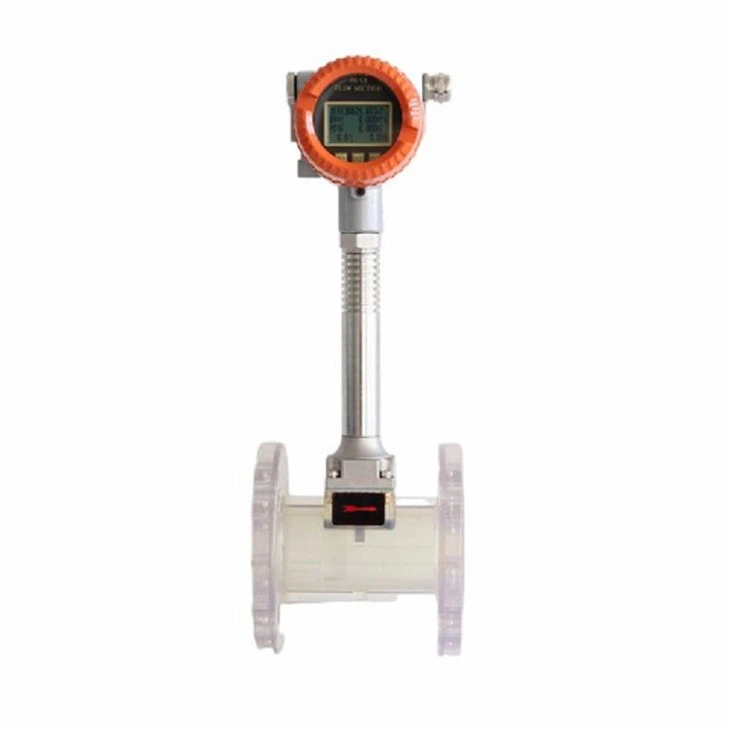
Now, let's talk about some of the products we offer. We have a Compact Vortex Flowmeter that is great for applications where space is limited. Despite its small size, it has excellent linearity and can accurately measure flow rates in a variety of fluids.
Our Steam Flowmeter is specifically designed for measuring the flow of steam. Steam is a tricky fluid to measure because of its high temperature and pressure. But our Steam Flowmeter is engineered to handle these conditions and maintain good linearity, ensuring accurate steam flow measurements.
And then there's our LUGB Flowmeter. This flowmeter is known for its reliability and wide range of applications. It has a robust design that helps to maintain linearity even in harsh industrial environments.
When it comes to choosing a Vortex Flowmeter, it's important to consider the linearity requirements of your specific application. You need to think about the range of flow rates you'll be dealing with, the type of fluid, and the accuracy you need. If you're not sure which flowmeter is right for you, our team of experts is here to help. We can analyze your application and recommend the best Vortex Flowmeter based on your needs.
In conclusion, the linearity of a Vortex Flowmeter is a critical factor in ensuring accurate and reliable flow measurements. By understanding the factors that affect linearity and choosing the right flowmeter for your application, you can improve the efficiency and performance of your industrial processes.
If you're interested in learning more about our Vortex Flowmeters or have any questions about linearity or other technical aspects, don't hesitate to get in touch. We're always happy to have a chat and discuss how our products can meet your flow measurement needs. Whether you're looking to upgrade an existing system or install a new one, we're here to support you every step of the way. Let's work together to find the perfect Vortex Flowmeter solution for your business.
References
- "Flow Measurement Handbook: Industrial Designs and Applications" by Richard W. Miller
- "Instrumentation and Control Systems" by Alan S. Morris