

Hey there! As a supplier of High Accuracy Flowmeters, I often get asked about the differences between high accuracy gas flowmeters and liquid flowmeters. Well, let's dive right in and break it down.
First off, let's talk about what flowmeters are in general. Flowmeters are devices used to measure the flow rate of either gases or liquids. They're super important in a whole bunch of industries, from oil and gas to food and beverage. And when you need precise measurements, that's where high accuracy flowmeters come in.
One of the most obvious differences between gas and liquid flowmeters is the nature of the substances they measure. Gases are compressible, which means their density can change depending on factors like pressure and temperature. Liquids, on the other hand, are generally considered incompressible. This difference has a huge impact on how the flowmeters work.
Let's start with high accuracy gas flowmeters. These are designed to handle the unique properties of gases. One common type is the thermal mass flowmeter. It works by measuring the heat transfer from a heated sensor to the flowing gas. The rate of heat transfer is directly related to the mass flow rate of the gas. Thermal mass flowmeters are great because they can measure the mass flow rate directly, without needing to account for changes in pressure and temperature. They're also very accurate and can handle a wide range of gas flow rates. Check out this Mass Flowmeter for more info on mass flow measurement.
Another type of gas flowmeter is the ultrasonic flowmeter. It uses ultrasonic waves to measure the flow rate of the gas. The principle is based on the fact that the speed of sound in a gas changes depending on the flow velocity. By measuring the time it takes for the ultrasonic waves to travel upstream and downstream, the flow rate can be calculated. Ultrasonic flowmeters are non - intrusive, which means they don't need to be inserted into the gas stream, reducing the risk of contamination and pressure drop.
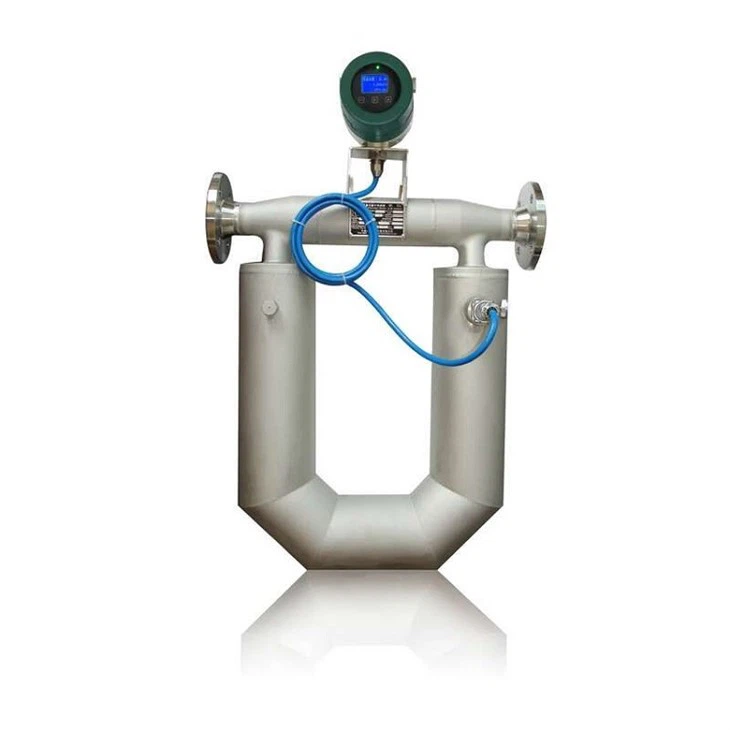
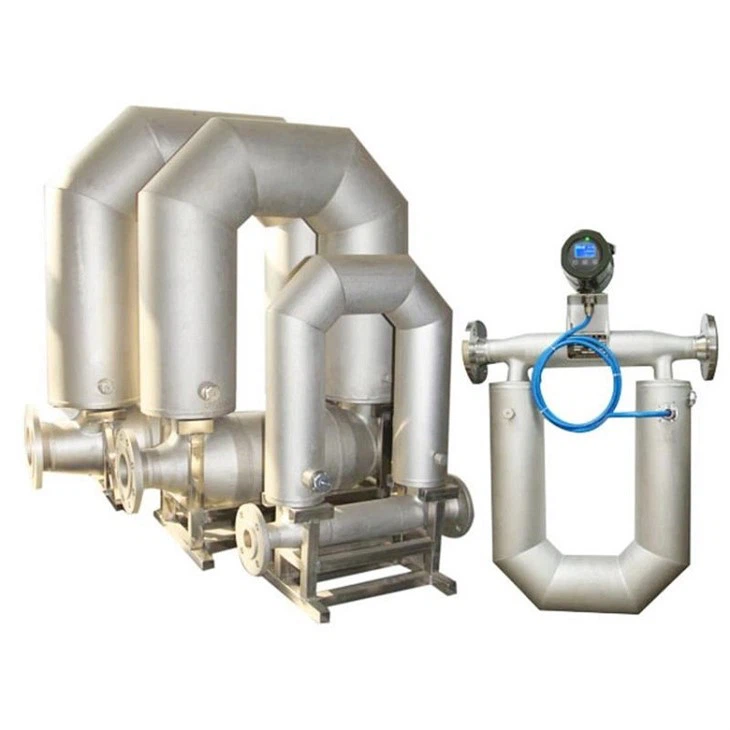
Now, let's move on to liquid flowmeters. One of the most popular types is the Coriolis mass flowmeter. It works on the Coriolis effect, which is the deflection of a moving object due to the rotation of the Earth (although in this case, it's the rotation of a vibrating tube). When a liquid flows through the vibrating tube, the Coriolis force causes a twist in the tube. The amount of twist is directly proportional to the mass flow rate of the liquid. Coriolis mass flowmeters are extremely accurate and can measure both the mass flow rate and the density of the liquid at the same time. If you're interested in a high - precision liquid flow measurement, take a look at our High Accuracy Flowmeter.
Another common liquid flowmeter is the electromagnetic flowmeter. It works based on Faraday's law of electromagnetic induction. When a conductive liquid flows through a magnetic field, a voltage is induced. The magnitude of this voltage is proportional to the flow velocity of the liquid. Electromagnetic flowmeters are great for measuring the flow of conductive liquids, such as water and some chemical solutions. They're also very accurate and have a low pressure drop.
Accuracy is a key factor when choosing between gas and liquid flowmeters. High accuracy flowmeters are designed to provide precise measurements, but the level of accuracy can vary depending on the type of flowmeter and the application. Gas flowmeters need to account for the compressibility of gases, which can make achieving high accuracy a bit more challenging. Liquid flowmeters, on the other hand, can often achieve higher levels of accuracy because liquids are less affected by changes in pressure and temperature.
Installation and maintenance are also important considerations. Gas flowmeters may require more careful installation to ensure accurate measurements, especially when dealing with high - pressure or high - temperature gases. They may also need more frequent calibration to account for changes in gas properties. Liquid flowmeters are generally easier to install and maintain, but they still need to be properly calibrated and maintained to ensure accurate measurements.
In terms of applications, gas flowmeters are commonly used in industries such as natural gas distribution, chemical processing, and environmental monitoring. They're used to measure the flow of gases like natural gas, oxygen, and nitrogen. Liquid flowmeters, on the other hand, are widely used in industries such as water treatment, food and beverage production, and pharmaceutical manufacturing. For example, in the food and beverage industry, Coriolis Mass Flowmeter for Drinking can be used to measure the flow of liquids like milk, juice, and beer.
So, there you have it! The main differences between high accuracy gas flowmeters and liquid flowmeters. Whether you're in the market for a gas flowmeter or a liquid flowmeter, we've got you covered. Our high accuracy flowmeters are designed to meet the most demanding applications and provide reliable, precise measurements.
If you're interested in learning more about our products or have any questions about choosing the right flowmeter for your application, don't hesitate to reach out. We're here to help you make the best decision for your business. Let's start a conversation about your flow measurement needs and see how we can work together.
References:
- "Flow Measurement Handbook: Industrial Designs and Applications" by Richard W. Miller
- "Instrumentation, Measurement, and Analysis" by Alan S. Morris


