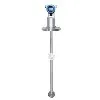
Hey there! As a flowmeter supplier, I often get asked about how different types of flowmeters work. Today, I'm gonna focus on optical flowmeters and explain how they measure flow.
First off, let's understand what an optical flowmeter is. In simple terms, it's a device that uses light to measure the flow of a fluid, whether it's a liquid or a gas. It's a pretty nifty piece of tech that has a bunch of advantages, like being non - intrusive and having high accuracy in many applications.
The Basics of Optical Flow Measurement
So, how does it all start? Well, an optical flowmeter typically has a light source and a detector. The light source can be an LED or a laser, depending on the design and the requirements of the measurement. The light is directed into the fluid flow.
When the light enters the fluid, it interacts with the particles or the flow characteristics of the fluid. If the fluid has some sort of scattering elements, like particles in a liquid or density variations in a gas, the light gets scattered. This scattering is what the detector is looking for.
Let's say we're measuring the flow of a liquid with some small particles suspended in it. As the light passes through the liquid, these particles scatter the light in different directions. The detector is placed at a specific angle to capture this scattered light.
The key thing here is that the amount and pattern of the scattered light are related to the flow of the fluid. For example, if the fluid is flowing faster, the movement of the particles will be more rapid, and this will change the way the light is scattered. The detector can pick up these changes and convert them into electrical signals.
Doppler Effect in Optical Flowmeters
One of the common principles used in optical flowmeters is the Doppler effect. You might have heard of this in the context of sound waves, but it also applies to light. When the light is scattered by moving particles in the fluid, the frequency of the scattered light changes.
If the particles are moving towards the detector, the frequency of the scattered light increases. If they're moving away, the frequency decreases. This frequency shift is called the Doppler shift.

The optical flowmeter measures this Doppler shift to determine the velocity of the particles in the fluid. Since the velocity of the particles is related to the flow velocity of the fluid, the meter can then calculate the flow rate.
Let's break it down a bit more. The flowmeter has a built - in signal processing unit. This unit analyzes the frequency of the light received by the detector. It compares the frequency of the scattered light with the original frequency of the light emitted by the source. The difference in these frequencies gives the Doppler shift.
Once the Doppler shift is known, the unit can use a mathematical formula to calculate the velocity of the particles. And by knowing the cross - sectional area of the pipe or the channel where the fluid is flowing, the flow rate can be determined.
Phase - Shift Measurement
Another method used in optical flowmeters is phase - shift measurement. In this case, the flowmeter emits two beams of light. These beams are usually parallel to each other and are directed into the fluid flow.
As the fluid flows, it causes a phase difference between the two beams. The detector measures this phase difference. The phase difference is proportional to the velocity of the fluid.
The signal processing unit in the flowmeter takes the measured phase difference and uses it to calculate the fluid velocity. Just like with the Doppler method, once the velocity is known, and the cross - sectional area of the flow path is given, the flow rate can be calculated.
Advantages of Optical Flowmeters
Now, you might be wondering why optical flowmeters are so popular. Well, there are several reasons.
First of all, they're non - intrusive. This means that they don't need to be inserted into the fluid flow. You can just mount them on the outside of a pipe, and they can still measure the flow. This is great because it doesn't disrupt the flow, and there's no risk of contamination or damage to the flowmeter from the fluid.
Secondly, they have high accuracy. Optical flowmeters can measure flow rates with a high degree of precision, especially in applications where the fluid has a certain amount of scattering elements.
They also have a wide range of applications. They can be used in industries like chemical processing, food and beverage, and water treatment. For example, in the food and beverage industry, they can be used to measure the flow of liquids like milk or fruit juices without the risk of contamination.
Applications in Different Industries
In the chemical industry, optical flowmeters are used to measure the flow of various chemicals. Since many chemicals can be corrosive or hazardous, the non - intrusive nature of optical flowmeters is a big advantage. They can accurately measure the flow of these chemicals without being damaged by them.
In the water treatment industry, optical flowmeters are used to measure the flow of water in pipes. This helps in monitoring and controlling the treatment process. For example, they can be used to ensure that the right amount of chemicals is added to the water based on the flow rate.
In the oil and gas industry, optical flowmeters can be used to measure the flow of crude oil or natural gas. They can provide accurate flow measurements even in harsh environments.
Complementary Devices
Sometimes, optical flowmeters are used in conjunction with other devices. For example, the Rosemount 3051C Smart Pressure Transmitter can be used along with an optical flowmeter. The pressure transmitter can measure the pressure of the fluid, and this information can be used in combination with the flow rate measured by the optical flowmeter. This can help in getting a more comprehensive understanding of the fluid system, such as calculating the energy consumption or detecting any blockages in the pipes.
Conclusion
So, there you have it! That's how an optical flowmeter measures flow. It's a combination of light technology, signal processing, and some cool physical principles like the Doppler effect and phase - shift measurement.
If you're in the market for a reliable flowmeter for your industrial application, optical flowmeters are definitely worth considering. They offer high accuracy, non - intrusive measurement, and a wide range of applications.
If you're interested in learning more or want to discuss your specific flow measurement needs, feel free to reach out. We're here to help you find the best flowmeter solution for your business.
References
- "Flow Measurement Handbook: Industrial Designs and Applications" by Richard W. Miller
- "Optical Flow Measurement Techniques" by various authors in the Journal of Flow Measurement and Instrumentation