How does a turbine gas flowmeter work?
As a supplier of Gas Flowmeters, I'm often asked about the working principles of our products, especially the turbine gas flowmeter. In this blog post, I'll delve into the details of how a turbine gas flowmeter operates, its advantages, and its applications.


The Basics of Turbine Gas Flowmeters
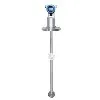
A turbine gas flowmeter is a type of volumetric flowmeter that measures the flow rate of gases. It consists of a housing, a turbine rotor, and a sensor. The gas enters the flowmeter through the inlet and passes over the turbine rotor. The force of the gas causes the turbine rotor to spin, and the speed of the rotation is directly proportional to the flow rate of the gas.
The sensor, typically a magnetic or optical sensor, detects the rotation of the turbine rotor and generates electrical pulses. These pulses are then transmitted to a flow computer or a control system, which calculates the flow rate based on the number of pulses received.
Working Principle in Detail
Let's take a closer look at the working principle of a turbine gas flowmeter. When the gas enters the flowmeter, it first passes through a flow conditioner. The flow conditioner straightens the gas flow and ensures that it is evenly distributed across the turbine rotor. This is important because any uneven flow can cause the turbine rotor to spin unevenly, leading to inaccurate flow measurements.
Once the gas passes through the flow conditioner, it reaches the turbine rotor. The turbine rotor is designed with a series of blades that are angled to catch the gas flow. As the gas flows over the blades, it exerts a force on them, causing the turbine rotor to rotate. The speed of the rotation is determined by the flow rate of the gas. The higher the flow rate, the faster the turbine rotor spins.
The sensor is located near the turbine rotor and detects the rotation of the blades. In a magnetic sensor, the turbine rotor is equipped with a magnet, and as the rotor spins, the magnet passes by the sensor, generating a magnetic field change. This change is detected by the sensor and converted into an electrical pulse. In an optical sensor, the turbine rotor is equipped with a reflective surface, and as the rotor spins, the reflective surface passes by the sensor, reflecting a light beam. The sensor detects the reflection and generates an electrical pulse.
The electrical pulses generated by the sensor are then transmitted to a flow computer or a control system. The flow computer or control system counts the number of pulses received over a specific period of time and calculates the flow rate based on the known relationship between the number of pulses and the volume of gas that has passed through the flowmeter.
Advantages of Turbine Gas Flowmeters
Turbine gas flowmeters offer several advantages over other types of flowmeters. Firstly, they are highly accurate. They can measure the flow rate of gases with an accuracy of up to ±0.5%, making them suitable for applications where precise flow measurements are required.
Secondly, they have a wide turndown ratio. The turndown ratio is the ratio of the maximum flow rate to the minimum flow rate that a flowmeter can measure accurately. Turbine gas flowmeters typically have a turndown ratio of 10:1 or higher, which means they can accurately measure a wide range of flow rates.
Thirdly, they are relatively simple in design and easy to install and maintain. They have few moving parts, which reduces the risk of mechanical failure and makes them more reliable.
Finally, they are suitable for a wide range of gases, including natural gas, propane, air, and other industrial gases.
Applications of Turbine Gas Flowmeters
Turbine gas flowmeters are widely used in various industries for measuring the flow rate of gases. Some of the common applications include:
- Natural Gas Industry: Turbine gas flowmeters are used to measure the flow rate of natural gas in pipelines, storage facilities, and distribution networks. They are also used in natural gas production and processing plants to measure the flow rate of gas at different stages of the production process.
- Industrial Processes: They are used in industrial processes such as chemical manufacturing, food and beverage production, and power generation to measure the flow rate of gases used in the processes. For example, in a chemical manufacturing plant, turbine gas flowmeters can be used to measure the flow rate of reactant gases.
- HVAC Systems: Turbine gas flowmeters are used in heating, ventilation, and air conditioning (HVAC) systems to measure the flow rate of air or other gases. This helps in ensuring the efficient operation of the HVAC system and maintaining the desired indoor air quality.
Comparison with Other Types of Flowmeters
While turbine gas flowmeters have many advantages, it's important to note that they are not suitable for all applications. For example, they may not be suitable for measuring the flow rate of dirty or viscous gases, as the dirt or viscosity can cause the turbine rotor to clog or slow down, leading to inaccurate measurements.
In such cases, other types of flowmeters such as Gas Roots Flowmeter or Roots Flowmeter for Gas may be more suitable. Gas Roots flowmeters are positive displacement flowmeters that measure the flow rate of gases by trapping and measuring discrete volumes of gas. They are more suitable for measuring the flow rate of dirty or viscous gases, as they are less affected by the properties of the gas.
Conclusion
In conclusion, turbine gas flowmeters are a reliable and accurate way to measure the flow rate of gases. They work based on the principle of using the force of the gas flow to spin a turbine rotor, and the speed of the rotation is used to calculate the flow rate. They offer several advantages such as high accuracy, wide turndown ratio, and ease of installation and maintenance. However, they may not be suitable for all applications, and in some cases, other types of flowmeters may be more appropriate.
If you're in the market for a gas flowmeter and need more information about our Gas Flowmeter products, please feel free to contact us for a detailed discussion. We have a team of experts who can help you choose the right flowmeter for your specific application and provide you with the best possible solution.
References
- "Flow Measurement Handbook: Industrial Designs and Applications" by Ralph W. Miller
- "Process Instrumentation and Control Handbook" by Bela G. Liptak