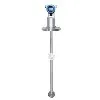
As a supplier of High Accuracy Flowmeters, I've witnessed firsthand the critical role these devices play in various industries. One of the most common challenges faced when measuring fluid flow is accounting for changes in fluid density. In this blog, I'll delve into how our high - accuracy flowmeters address this issue.
Understanding the Impact of Fluid Density on Flow Measurement
Fluid density is a fundamental property that can significantly affect flow measurement. Density is defined as the mass per unit volume of a fluid. Changes in density can occur due to several factors, such as temperature, pressure, and the composition of the fluid. For example, as the temperature of a fluid increases, its density typically decreases because the molecules move farther apart. Similarly, changes in pressure can compress or expand a fluid, altering its density.
In flow measurement, density changes can lead to inaccurate readings if not properly accounted for. Traditional flowmeters that measure volumetric flow rate may provide misleading results when the fluid density varies. This is because volumetric flow rate measures the volume of fluid passing through a point per unit time, without considering the mass of the fluid. In many industrial applications, however, it is the mass of the fluid that is of primary importance, such as in chemical processes where the amount of reactant is crucial for the reaction outcome.
How High Accuracy Flowmeters Overcome Density Challenges
Our High Accuracy Flowmeters are designed to address the issue of changing fluid density through advanced measurement principles and technologies.
Coriolis Mass Flowmeters
One of the most effective solutions we offer is the Coriolis Mass Flowmeter for Drinking. Coriolis mass flowmeters operate on the principle of the Coriolis effect. When a fluid flows through a vibrating tube, the Coriolis force causes the tube to twist. The amount of twist is directly proportional to the mass flow rate of the fluid.
Since the measurement is based on mass, Coriolis mass flowmeters are inherently immune to changes in fluid density, temperature, and pressure. The mass flow rate is a measure of the actual amount of fluid passing through the flowmeter, regardless of its density. This makes Coriolis mass flowmeters highly accurate in a wide range of applications, from measuring the flow of drinking water to handling complex chemical mixtures.
In addition to measuring mass flow rate, Coriolis mass flowmeters can also provide direct measurements of fluid density. By analyzing the natural frequency of the vibrating tube, the density of the fluid can be determined. This additional information is valuable for process control and quality assurance, as it allows operators to monitor the properties of the fluid in real - time.
Advanced Sensor Technology
Our high - accuracy flowmeters are equipped with advanced sensors that can detect even the slightest changes in fluid properties. These sensors are designed to be highly sensitive and reliable, ensuring accurate measurements under various operating conditions.
For example, some of our flowmeters use temperature sensors to monitor the temperature of the fluid. By knowing the temperature, the flowmeter can apply appropriate corrections to the measurement based on the known relationship between temperature and density for a particular fluid. Similarly, pressure sensors can be used to account for pressure - induced density changes.
The data from these sensors is processed by sophisticated algorithms within the flowmeter. These algorithms take into account the physical properties of the fluid, such as its thermal expansion coefficient and compressibility, to calculate the correct mass flow rate.
Applications in Different Industries
The ability to account for changes in fluid density makes our high - accuracy flowmeters suitable for a wide range of industries.
Chemical Industry
In the chemical industry, precise measurement of reactants and products is essential for ensuring the quality and consistency of chemical processes. Our Mass Flowmeter can accurately measure the mass flow of various chemicals, regardless of their density variations. This is crucial for reactions where the stoichiometry must be precisely controlled. For example, in the production of pharmaceuticals, even a small error in the measurement of a reactant can lead to significant differences in the final product quality.
Food and Beverage Industry
In the food and beverage industry, our high - accuracy flowmeters are used to measure the flow of ingredients such as milk, juice, and syrup. These fluids can have different densities depending on their composition and temperature. Our High Accuracy Flowmeter can ensure accurate dosing and mixing, resulting in consistent product quality. For example, in the production of carbonated beverages, the correct amount of carbon dioxide must be added to the liquid, and accurate flow measurement is essential for this process.
Oil and Gas Industry
In the oil and gas industry, fluid density can vary significantly due to factors such as the type of hydrocarbon, temperature, and pressure. Our flowmeters can accurately measure the mass flow of crude oil, natural gas, and refined products. This is important for custody transfer applications, where accurate measurement of the amount of oil or gas being transferred is crucial for financial transactions.
Benefits of Using Our High Accuracy Flowmeters
Using our high - accuracy flowmeters that account for changes in fluid density offers several benefits to our customers.
Improved Accuracy
The most obvious benefit is improved measurement accuracy. By accounting for density changes, our flowmeters can provide more precise and reliable measurements, reducing errors in process control and product quality. This can lead to significant cost savings by minimizing waste and improving the efficiency of industrial processes.


Reduced Maintenance
Our flowmeters are designed to be robust and reliable, with few moving parts. This reduces the need for frequent maintenance and calibration, resulting in lower operating costs. Additionally, the advanced sensor technology and algorithms in our flowmeters ensure that the measurements remain accurate over time, even in harsh operating environments.
Enhanced Process Control
Accurate flow measurement allows for better process control. By knowing the exact mass flow rate of a fluid, operators can make more informed decisions about process parameters such as flow rate, temperature, and pressure. This can lead to improved product quality, increased productivity, and reduced energy consumption.
Conclusion
In conclusion, accounting for changes in fluid density is a critical aspect of accurate flow measurement. Our high - accuracy flowmeters, including the Coriolis mass flowmeters, are designed to overcome the challenges posed by density variations. With advanced sensor technology and sophisticated algorithms, our flowmeters can provide accurate mass flow measurements in a wide range of applications and industries.
If you're looking for a reliable solution for your flow measurement needs, we invite you to contact us for a detailed discussion. Our team of experts can help you select the right flowmeter for your specific application and provide you with the support you need to ensure its optimal performance.
References
- Beck, M. S., & Plaskowski, A. (1987). Flow Measurement. Chapman and Hall.
- Spitzer, D. W. (2001). Flow Measurement: Practical Guides for Measurement and Control. ISA - The Instrumentation, Systems, and Automation Society.
- Miller, R. W. (1983). Flow Measurement Engineering Handbook. McGraw - Hill.