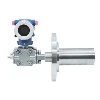
Hey there! I'm a supplier of Gas Roots Flowmeter, and today I wanna chat about how these nifty devices work in a humid gas environment.
First off, let's quickly go over what a Gas Roots Flowmeter is. It's a type of positive displacement flowmeter that's widely used to measure the volume of gas flowing through a pipeline. It's got two counter - rotating rotors (usually shaped like figure - 8s) that trap and transfer fixed volumes of gas from the inlet to the outlet of the meter with each rotation.
Now, when we talk about a humid gas environment, things get a bit more complicated. Humid gas contains water vapor, and this water vapor can have several effects on the operation of a Gas Roots Flowmeter.
Effects of Humidity on the Gas Properties
The presence of water vapor changes the physical properties of the gas mixture. One of the key properties affected is the density. As the humidity increases, the density of the gas mixture decreases because water vapor is less dense than most of the common gases in industrial applications, like natural gas or air. This change in density can impact the flow measurement because the Gas Roots Flowmeter measures the volume of the gas. If the density changes, the mass flow rate (which is often what we're really interested in) will also change for a given volume flow rate.
Another property affected is the viscosity. Water vapor can increase the viscosity of the gas mixture. Higher viscosity means that the gas will flow more slowly and will offer more resistance to the movement of the rotors in the flowmeter. This can lead to increased wear and tear on the rotors and other moving parts of the meter.
How the Gas Roots Flowmeter Handles Humidity
Despite these challenges, Gas Roots Flowmeters are designed to work reasonably well in humid gas environments. The design of the rotors is crucial here. The rotors are precisely machined to ensure a tight seal between them and the housing of the flowmeter. This helps to prevent any gas leakage, even when the gas is humid.
The materials used in the construction of the flowmeter also play an important role. Most Gas Roots Flowmeters are made from materials that are resistant to corrosion. Since water vapor can cause corrosion, especially if there are other contaminants in the gas, using corrosion - resistant materials like stainless steel or special coatings can extend the lifespan of the flowmeter.
The flowmeter also has a built - in calibration mechanism. When the flowmeter is installed, it's calibrated for the specific gas composition and operating conditions, including humidity. This calibration takes into account the expected changes in gas properties due to humidity, so that the flow measurement remains accurate within an acceptable range.
Challenges in Humid Gas Environments
However, there are still some challenges that we need to be aware of. One of the biggest challenges is the potential for condensation. When the temperature of the gas drops, the water vapor in the gas can condense into liquid water. This liquid water can cause problems in the flowmeter. It can disrupt the smooth rotation of the rotors, leading to inaccurate flow measurements. It can also cause corrosion in areas where the protective coatings may be damaged or where there are small crevices.
Another challenge is the presence of contaminants in the humid gas. Water vapor can act as a carrier for contaminants like dust, dirt, and chemical substances. These contaminants can accumulate on the rotors and other internal parts of the flowmeter, causing additional wear and reducing the accuracy of the measurement.
Solutions to Overcome Challenges
To deal with condensation, we can use heaters or insulation around the flowmeter. Heaters can keep the temperature of the gas above the dew point, preventing the water vapor from condensing. Insulation can also help to maintain a more stable temperature and reduce the likelihood of condensation.
For dealing with contaminants, we can install filters upstream of the flowmeter. These filters can remove the solid and liquid particles from the gas before it enters the flowmeter, protecting the internal components from damage.
Why Choose Our Gas Roots Flowmeters
As a supplier of Gas Roots Flowmeters, we've put a lot of effort into making our products suitable for humid gas environments. Our flowmeters are designed with the latest technology to ensure high accuracy and reliability, even in challenging conditions.
We use high - quality materials that are not only corrosion - resistant but also durable. Our calibration process is very precise, taking into account all the possible factors that can affect the flow measurement in a humid gas environment.


If you're in the market for a Gas Flowmeter or a Roots Flowmeter for Gas, we'd love to have a chat with you. Whether you're dealing with a simple industrial application or a complex one with high humidity and contaminants, our team of experts can help you choose the right flowmeter for your needs.
If you're interested in learning more about our products or want to discuss a potential purchase, don't hesitate to reach out. We're here to answer all your questions and help you make an informed decision. Contact us today to start the conversation about how our Gas Roots Flowmeters can solve your flow measurement problems in humid gas environments.
References
- "Flow Measurement Handbook" by Richard W. Miller
- "Industrial Flow Measurement" by R. K. Rajput