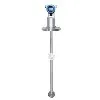
Can a Coriolis flowmeter be used in compressed air measurement applications?
In the realm of industrial measurement, the accurate quantification of compressed air is of paramount importance. Compressed air serves as a vital utility in numerous industries, powering pneumatic tools, automation systems, and various manufacturing processes. Selecting the right flowmeter for measuring compressed air is a decision that can significantly impact the efficiency, productivity, and cost - effectiveness of operations. As a Coriolis flowmeter supplier, I am often asked whether Coriolis flowmeters can be used in compressed air measurement applications. In this blog, I will delve into this question, exploring the principles of Coriolis flowmeters, the characteristics of compressed air, and the viability of using Coriolis flowmeters for this purpose.
Understanding Coriolis Flowmeters
Coriolis flowmeters operate on the principle of the Coriolis effect, which is the apparent deflection of moving objects when viewed in a rotating reference frame. In a Coriolis flowmeter, a fluid (either liquid or gas) is made to flow through one or more vibrating tubes. As the fluid moves through the vibrating tubes, the Coriolis force causes a phase shift in the vibration of the tubes. This phase shift is directly proportional to the mass flow rate of the fluid passing through the tubes.
One of the key advantages of Coriolis flowmeters is their ability to measure mass flow directly. Unlike volumetric flowmeters, which measure the volume of fluid passing through a point in a given time, Coriolis flowmeters provide a reading of the actual mass of the fluid. This is particularly useful in applications where the density of the fluid may vary due to changes in temperature, pressure, or composition. Additionally, Coriolis flowmeters offer high accuracy, typically in the range of ±0.1% to ±0.5% of the measured value. They are also relatively insensitive to changes in fluid viscosity, temperature, and pressure, making them suitable for a wide range of applications.
For more information on our Coriolis Mass Flowmeter for Drinking, you can visit our website.
Characteristics of Compressed Air
Compressed air is a compressible fluid, which means its density can change significantly with variations in pressure and temperature. The density of compressed air is directly proportional to its pressure and inversely proportional to its temperature. For example, if the pressure of compressed air increases while the temperature remains constant, the density of the air will increase. Conversely, if the temperature of compressed air increases while the pressure remains constant, the density of the air will decrease.


Another important characteristic of compressed air is its potential to contain contaminants such as moisture, oil, and particulate matter. These contaminants can affect the performance of flowmeters, causing fouling, corrosion, or inaccurate measurements. Therefore, when selecting a flowmeter for compressed air measurement, it is essential to consider the quality of the compressed air and the ability of the flowmeter to withstand the presence of contaminants.
Can Coriolis Flowmeters be Used for Compressed Air Measurement?
The answer to whether Coriolis flowmeters can be used for compressed air measurement is yes, but with some considerations.
Advantages of Using Coriolis Flowmeters for Compressed Air Measurement
- Direct Mass Flow Measurement: As mentioned earlier, Coriolis flowmeters measure mass flow directly. This is a significant advantage when measuring compressed air because the mass of the air is a more relevant parameter than its volume in many applications. For example, in a pneumatic system, the amount of work that can be done by the compressed air is related to its mass rather than its volume. By measuring the mass flow of compressed air, Coriolis flowmeters can provide more accurate information for process control and energy management.
- High Accuracy: Coriolis flowmeters offer high - accuracy measurements, which is crucial for applications where precise control of compressed air consumption is required. In industries such as semiconductor manufacturing, where even small variations in compressed air flow can affect product quality, the high accuracy of Coriolis flowmeters can help ensure consistent production processes.
- Insensitivity to Fluid Properties: Coriolis flowmeters are relatively insensitive to changes in fluid viscosity, temperature, and pressure. This means that they can provide accurate measurements of compressed air even when there are fluctuations in these parameters. For example, in a compressed air system where the pressure and temperature may vary due to changes in demand or environmental conditions, a Coriolis flowmeter can still maintain its measurement accuracy.
Challenges of Using Coriolis Flowmeters for Compressed Air Measurement
- Cost: Coriolis flowmeters are generally more expensive than some other types of flowmeters, such as turbine or orifice plate flowmeters. This higher cost may be a deterrent for some applications, especially those with budget constraints.
- Sensitivity to Vibration and Mounting: Coriolis flowmeters rely on the vibration of tubes to measure flow. Therefore, they can be sensitive to external vibrations, which can interfere with the measurement. Proper installation and mounting of the flowmeter are essential to minimize the effects of vibration. Additionally, the orientation of the flowmeter can also affect its performance, and it must be installed according to the manufacturer's recommendations.
- Contaminant Sensitivity: Although Coriolis flowmeters are relatively robust, the presence of contaminants in compressed air can still affect their performance. Contaminants such as moisture, oil, and particulate matter can accumulate on the vibrating tubes, causing changes in the tube's vibration characteristics and leading to inaccurate measurements. Therefore, it is necessary to ensure that the compressed air is properly filtered and dried before it enters the Coriolis flowmeter.
Considerations for Using Coriolis Flowmeters in Compressed Air Applications
If you are considering using a Coriolis flowmeter for compressed air measurement, the following factors should be taken into account:
- Flow Range: Determine the expected flow range of the compressed air in your application. Coriolis flowmeters have a specific flow range within which they can operate accurately. Make sure that the flow range of the selected flowmeter matches the requirements of your application.
- Pressure and Temperature: Consider the operating pressure and temperature of the compressed air. Coriolis flowmeters are designed to operate within certain pressure and temperature limits. Ensure that the operating conditions of your compressed air system are within the specified range of the flowmeter.
- Contaminant Removal: Implement proper filtration and drying systems to remove contaminants from the compressed air before it enters the flowmeter. This will help ensure the long - term performance and accuracy of the Coriolis flowmeter.
- Installation and Mounting: Follow the manufacturer's installation and mounting instructions carefully. Ensure that the flowmeter is installed in a location where it is not exposed to excessive vibration and that it is oriented correctly.
For more details on our Mass Flowmeter and High Accuracy Flowmeter, you can visit our website.
Conclusion
In conclusion, Coriolis flowmeters can be used for compressed air measurement applications, offering several advantages such as direct mass flow measurement, high accuracy, and insensitivity to fluid properties. However, there are also some challenges, including cost, sensitivity to vibration and mounting, and potential issues with contaminants. By carefully considering these factors and taking appropriate measures, such as proper installation, contaminant removal, and selection of the right flowmeter for the application, Coriolis flowmeters can provide reliable and accurate measurements of compressed air.
If you are interested in exploring the use of Coriolis flowmeters for your compressed air measurement needs, we invite you to contact us for further discussion and to start the procurement process. Our team of experts can help you select the most suitable flowmeter for your application and provide you with all the necessary support for installation and operation.
References
- "Flow Measurement Handbook: Industrial Designs and Applications" by Richard W. Miller
- "Coriolis Flowmeters: Fundamentals and Applications" by Richard A. Baker